Tag: Pride Pakistan

  • Beyond Boundaries: How Phone Searches and Digital Profiling Are Criminalizing LGBTQI+ Existence in Pakistan

    Beyond Boundaries: How Phone Searches and Digital Profiling Are Criminalizing LGBTQI+ Existence in Pakistan

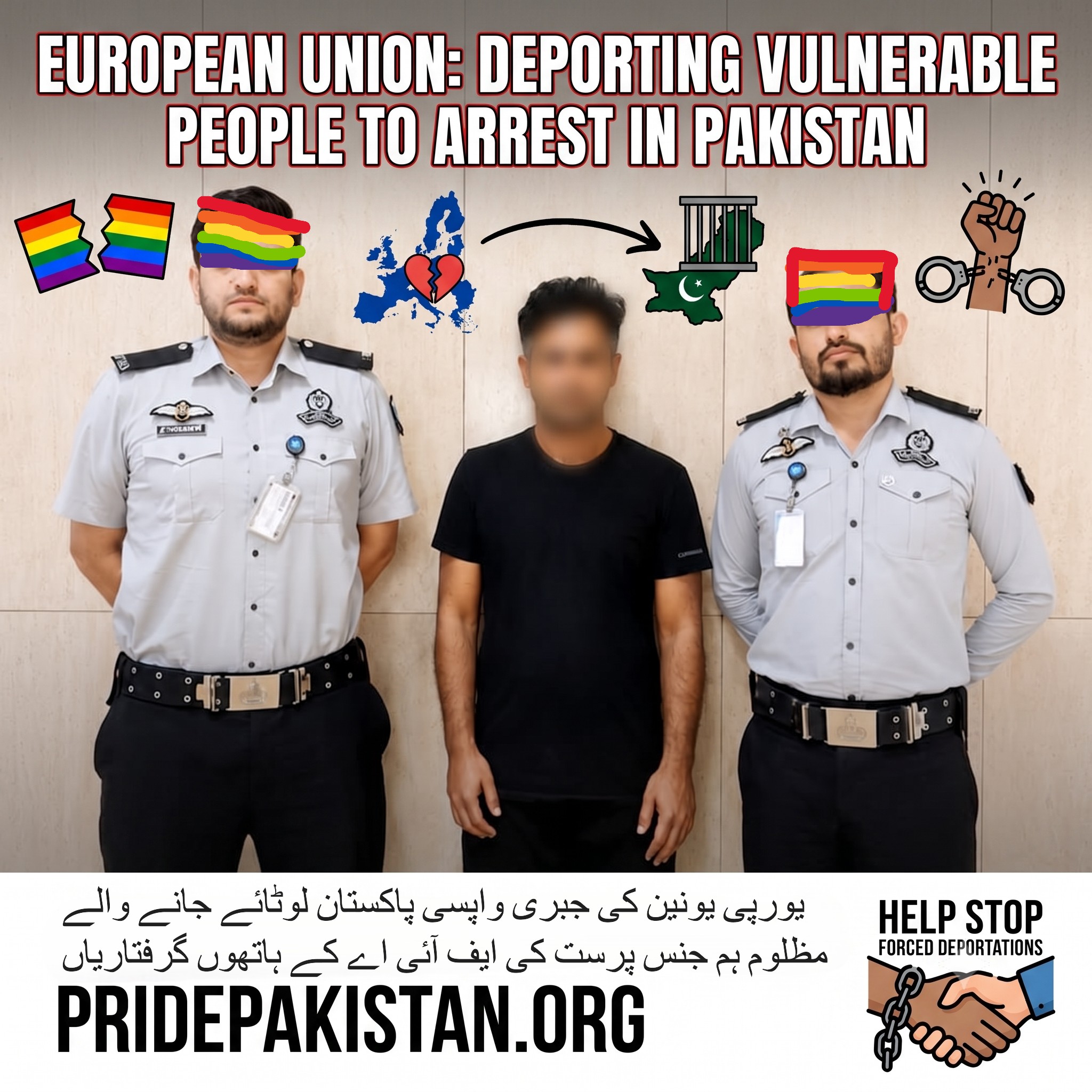
    Living as a gay or queer individual in Pakistan has long required navigating systemic prejudice and quiet survival. However, a dangerous escalation by state authorities is making even basic existence increasingly perilous. Law enforcement and border control agencies—including the Federal Investigation Agency (FIA) and local police—are actively violating individual privacy by conducting random, arbitrary checks of personal mobile phones to target, blackmail, and arrest individuals based on private social media conversations and text messages.

    This alarming pattern came to light once again in a recent case reported by national media (Jang News). A gay individual, previously deported from an European Union member state, was intercepted while traveling. During an inspection, FIA officers searched his personal phone, discovered private chat histories with his boyfriend, and subsequently arrested him, restricting his movement entirely on the grounds of his sexual orientation.

    This case is not an isolated incident. It exposes two critical, interconnected human rights crises: the dangerous flaws in Western asylum deportations, and the expanding surveillance state within Pakistan.

    From “Adult Content” to Criminalizing Identity

    Previously, authorities often relied on vague statutes regarding illegal or explicit digital media to confiscate devices or intimidate individuals. Now, state agencies have moved far beyond checking for restricted media. Personal chats, private WhatsApp messages, dating app profiles, or simple expressions of affection between consenting adults are now being weaponized as grounds for arrest, false FIRs (First Information Reports), and detention.

    When an individual’s private digital life is subjected to arbitrary search without a warrant or legal cause, the legal system ceases to operate on evidence of harm and instead becomes a tool for moral policing and state extortion.

    The Deadly EU Connection

    This case once again highlights the severe flaw in European immigration policies regarding queer asylum seekers. EU member states frequently reject asylum applications from LGBTQI+ Pakistanis under the false assumption that Pakistan is “safe enough” if individuals simply remain discreet.

    Yet, as this incident proves, discretion is impossible in an environment of arbitrary digital stop-and-frisks. When European authorities deport queer individuals back to Pakistan, they send them directly into a system where border officials inspect devices, uncover their identity, and immediately detain them upon arrival. By ignoring these realities, EU states are actively feeding vulnerable individuals back into a pipeline of state persecution.

    The Reality of Daily Life: Living in Constant Fear

    The weaponization of digital devices makes it virtually impossible for queer Pakistanis to live a normal, peaceful life. The psychological and social impact of this surveillance includes:

    • Constant Paranoia and Self-Censorship: Individuals are forced to constantly clear their search histories, delete private messages, or avoid keeping contact details of partners on their phones, fearing that a random police checkpoint or airport inspection could lead to immediate arrest.
    • Fabricated Charges and Extortion: Knowing the intense social stigma and legal vulnerability surrounding same-sex relations, corrupt officials frequently use private chats to fabricate severe FIRs, forcing victims or their terrified families to pay heavy bribes to avoid public exposure.
    • Complete Isolation: When digital spaces—the only place where many queer individuals can find community, peer support, or affirmative mental health advice—become surveillance traps, individuals are cut off from safe human connection, leading to severe mental health crises and despair.

    A Call for Accountability and Digital Privacy

    Every individual has a fundamental right to privacy, bodily autonomy, and freedom from arbitrary detention under international human rights law. State authorities in Pakistan must cease the illegal searching of personal electronic devices without due legal process and stop using private conversations to criminalize consenting adults.

    At the same time, international protection agencies and European immigration tribunals must recognize that as long as state agencies in Pakistan use digital profiling and phone searches to arrest gay individuals, returning asylum seekers to the country remains a direct violation of international human rights and the principle of non-refoulement.

    (Note: If you are accessing our website from within Pakistan, please ensure you use a VPN to view our resources safely.)
    حد سے آگے: فونز کی تلاشی اور ڈیجیٹل نگرانی کے ذریعے پاکستانیوں کو نشانہ بنانے کا عمل

    پاکستان میں ہم جنس پرست افراد کے لیے زندگی ہمیشہ سے مشکلات کا شکار رہی ہے، لیکن اب سرکاری اداروں کا نیا رویہ اس وجود کو مزید خطرناک بنا رہا ہے۔ قانون نافذ کرنے والے اور سرحدی سیکیورٹی کے ادارے، بشمول فیڈرل انویسٹی گیشن ایجنسی اور مقامی پولیس، عام شہریوں کے موبائل فونز کی تلاشی لے کر اور ان کے نجی میسجز اور سوشل میڈیا چیٹس کو بنیاد بنا کر گرفتاریوں اور بلیک میلنگ کا سلسلہ چلا رہے ہیں۔

    یہ سنگین صورتحال حال ہی میں قومی اخبار جنگ کی رپورٹ کے ذریعے دوبارہ سامنے آئی۔ یورپی یونین کے ایک رکن ملک سے زبردستی واپس بھیجے گئے ایک شخص کو دورانِ سفر روک کر اس کے فون کی تلاشی لی گئی۔ متعلقہ اہلکاروں نے اس کے فون سے اس کے دوست کے ساتھ نجی چیٹ تلاش کی اور اس بنیاد پر اسے گرفتار کر کے اس کی نقل و حرکت پر مکمل پابندی لگا دی۔

    یہ واقعہ کوئی واحد واقعہ نہیں ہے، بلکہ یہ دو بڑے مسائل کو اجاگر کرتا ہے: یورپ کی پناہ گزین پالیسیوں کی ناکامی اور پاکستان میں شہریوں کی پرائیویسی کی شدید خلاف ورزی۔

    نجی معلومات سے لے کر گرفتاریوں تک

    ماضی میں اکثر غیر قانونی مواد کا بہانہ بنا کر فون ضبط کیے جاتے تھے، لیکن اب ادارے نجی پیغامات، واٹس ایپ چیٹس، اور اپلیکشنز پر کی گئی گفتگو کو باقاعدہ مقدمات، جعلی ایف آئی آرز، اور حراست کی بنیاد بنا رہے ہیں۔

    جب بغیر کسی قانونی جواز کے شہریوں کے موبائل فونز کی تلاشی لی جاتی ہے، تو قانون کا مقصد تحفظ کے بجائے عام لوگوں کو ڈرانے اور ان سے پیسے بٹورنے کا ذریعہ بن جاتا ہے۔

    یورپی یونین کا خطرناک کردار

    یہ واقعہ ایک بار پھر یورپ کی پناہ گزینوں سے متعلق پالیسی کی خامیاں سامنے لاتا ہے۔ یورپی ممالک اکثر یہ کہہ کر درخواستیں مسترد کر دیتے ہیں کہ پاکستان میں چھپ کر رہنا ممکن ہے۔

    لیکن جب پاکستانی ادارے ایئرپورٹس پر فونز کی تلاشی لے کر لوگوں کو گرفتار کر رہے ہوں، تو ایسی صورت میں محتاط رہنا ناٹ ممکن ہو جاتا ہے۔ یورپ سے ڈیپورٹ کیے جانے والے افراد کو سیدھا ان اداروں کے حوالے کر دیا جاتا ہے جو ان کی نجی معلومات دیکھ کر انہیں فوری حراست میں لے لیتے ہیں۔

    روزمرہ زندگی کے شدید اثرات

    فونز کی غیر قانونی تلاشی نے عام شہریوں کی زندگیوں کو شدید خوف میں مبتلا کر دیا ہے:

    • مسلسل خوف اور ہراس: لوگ اپنے فونز سے میسجز اور ہسٹری پاک کرنے پر مجبور ہیں تاکہ کسی بھی ناکے یا ایئرپورٹ پر تلاشی کے دوران گرفتاری سے بچ سکیں۔
    • جعلی مقدمات اور بلیک میلنگ: نجی چیٹس کا سہارا لے کر جعلی پرچے کاٹ دیے جاتے ہیں اور لوگوں کو بلیک میل کر کے بھاری رقم وصول کی جاتی ہے۔
    • تنہائی: جب آن لائن رابطے بھی غیر محفوظ ہو جائیں، تو لوگ ایک دوسرے سے کٹ جاتے ہیں اور شدید ذہنی تناؤ کا شکار ہو جاتے ہیں۔

    پرائیویسی اور بنیادی حقوق کا مطالبہ

    ہر شہری کا بنیادی حق ہے کہ اس کی پرائیویسی اور ذاتی زندگی کا احترام کیا جائے۔ پاکستان میں اداروں کو بغیر قانونی اجازت کے فونز کی تلاشی کا یہ سلسلہ فوری بند کرنا چاہیے۔

    اس کے ساتھ ساتھ بین الاقوامی اداروں کو بھی یہ سمجھنا ہو گا کہ جب تک یہاں پرائیویٹ چیٹس کی بنیاد پر گرفتاریوں کا سلسلہ جاری ہے، تب تک لوگوں کو واپس بھیجنا انسانی حقوق کے بین الاقوامی اصولوں کی کھلی خلاف ورزی ہے۔

    (نوٹ: پاکستان میں ہماری ویب سائٹ کھولنے کے لیے وی پی این کا استعمال کریں۔)
  • Exposed and Persecuted: How Pakistani Police Weaponize Criminal Laws and Social Media Against Gay Minors

    Exposed and Persecuted: How Pakistani Police Weaponize Criminal Laws and Social Media Against Gay Minors

    نابالغ ہم جنس پرستوں کو نشانہ بنانا: پولیس کا سوشل میڈیا پر ٹرائل اور قانونی شقوں کا غلط استعمال

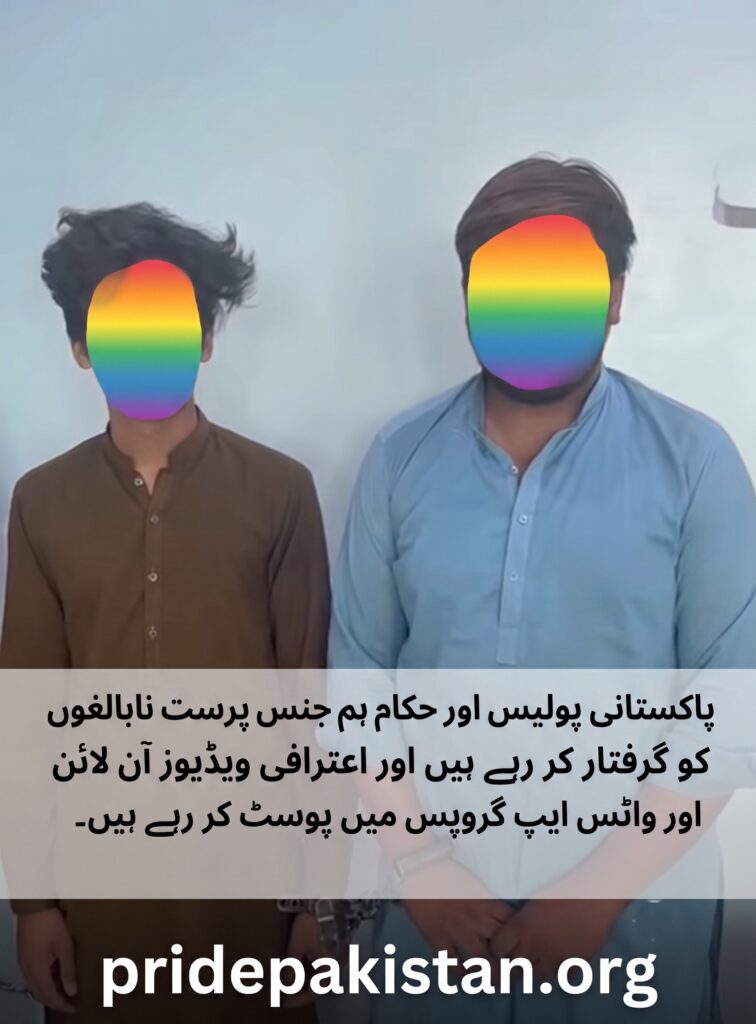
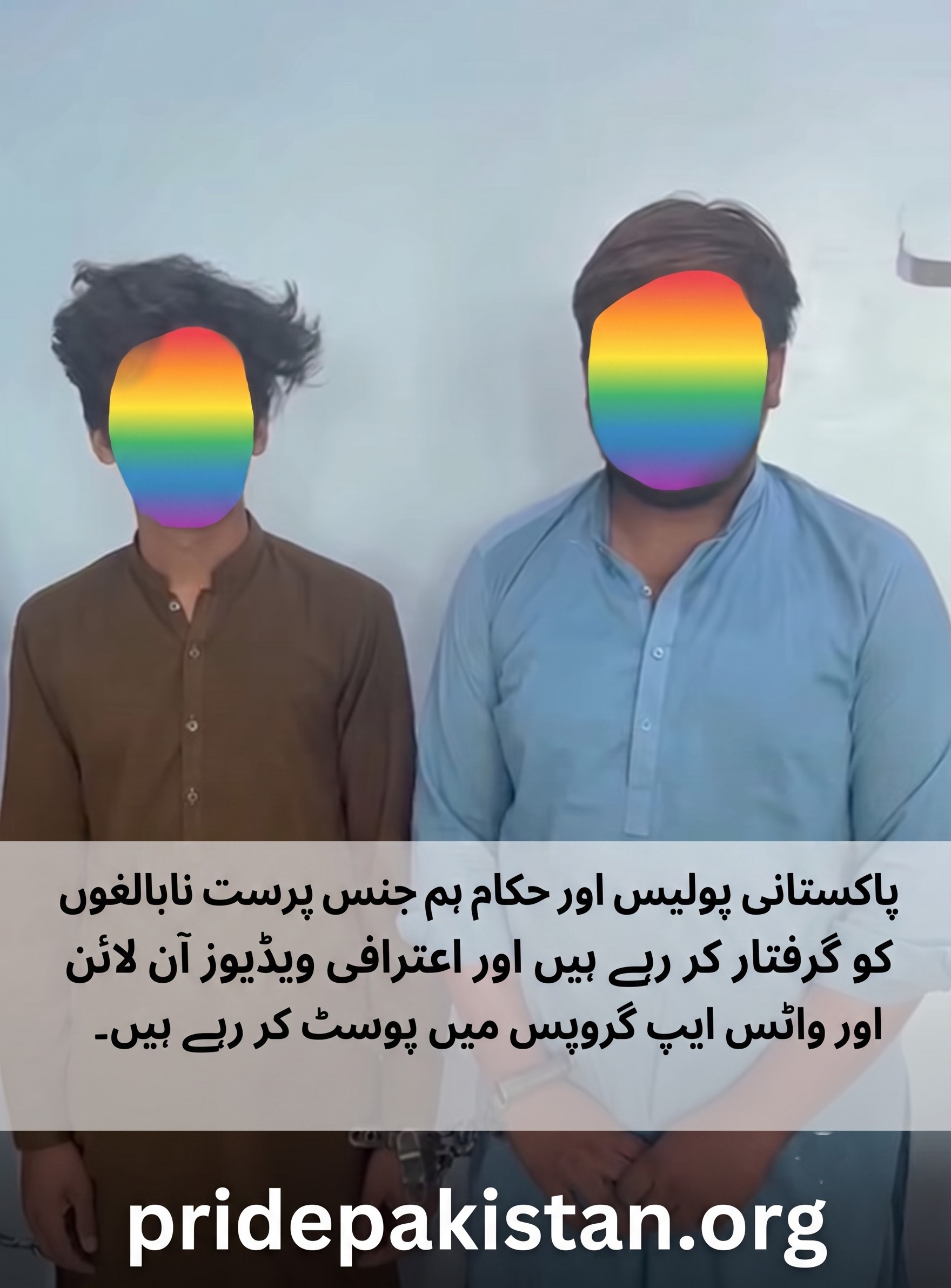
    In a alarming trend across Pakistan, police authorities are increasingly targeting, arresting, and publicly shaming gay and queer minors. Rather than protecting vulnerable youth, law enforcement agencies are weaponizing severe criminal statutes—often framing consensual or vulnerable same-sex encounters under heavy charges like gang rape (ijtimai ziyadati)—to justify unlawful detentions, extort families, and boost their public image.

    A recent incident involving the Stra Police Station (Thana Stra) in Punjab highlights the terrifying reality faced by young queer individuals in the country.

    The Incident: Public Shaming and Misuse of the Law

    In a video posted directly to social media by the Station House Officer (SHO), police celebrated the swift arrest of two minors, claiming credit for apprehending suspects in an alleged gang rape case:

    Police Statement:

    “ایس ایچ و تھانہ ستراہ چوہدری اکرم شہباز گجر کی بروقت کاروائی اجتماعی زیادتی کے ملزمان فوری گرفتار کرلئے اہلیان تھانہ ستراہ نے ایس ایچ او اکرم شہباز کی کارکردگی پر خراج تحسین پیش کیا چوہدری اکرم شہباز نے بتایا کہ ملزمان کو عدالت سے بہترین تفیتیش کی بدولت قرار واقعی سزا دلوائی جائے گی”

    (Timely action by SHO Stra Police Station, Chaudhry Akram Shahbaz Gujjar: Suspects of gang rape arrested immediately. Residents praised the performance of SHO Akram Shahbaz. Chaudhry Akram Shahbaz stated that through thorough investigation, the suspects will be given exemplary punishment by the court.)

    Beyond the severe legal charges leveled against these minors, the police officer personally recorded a video of the detained youth and published it online across social media platforms, boasting that the department would ensure they receive “exemplary punishment.”

    A Pattern of Abuse Across Pakistan

    This is not an isolated event. Similar cases involving gay and queer minors are surfacing with alarming frequency across various districts in Pakistan:

    1. Manipulation of Criminal Charges: Consensual same-sex relationships among young people or instances of police entrapment are routinely converted into non-bailable, heavy charges such as rape (Section 376 PPC), gang rape, or unnatural offenses (Section 377 PPC). By framing these cases under the umbrella of violent crime, police bypass basic juvenile protections and rally public hostility against the minors.
    2. Violations of Juvenile Rights and Privacy: Under both Pakistani law (the Juvenile Justice System Act, 2018) and international human rights conventions, the identity, privacy, and dignity of minors in custody must be strictly protected. Recording videos of detained children and broadcasting their faces on social media for public praise directly violates juvenile protection laws and destroys the lives of these minors before any court trial even begins.
    3. Forced Confessions and Public Trials by Media: Posting media content of detained individuals creates a public verdict long before due process takes place. As highlighted in international human rights reports, a vast majority of prisoners in Pakistan are held without fair trials, often coerced into making video statements under police duress and threats of physical abuse.

    The Human Rights Impact

    When police officers use social media to parade arrested minors as trophies for public approval, they expose these children to extreme societal violence, honor-related threats, and permanent psychological trauma. Framing queer youth under severe rape laws rather than recognizing their vulnerability strips them of fair legal representation and leaves families terrified to seek justice.

    Pride Pakistan calls upon child protection bureaus, legal advocacy groups, and human rights watchdogs to hold police officials accountable for filming and publishing videos of minors, to monitor the misuse of severe criminal charges against queer youth, and to ensure that juvenile justice laws are strictly enforced across all police jurisdictions.

    (Note: If you are accessing our website from within Pakistan, please ensure you use a VPN to view our resources safely.)

    Source: https://www.facebook.com/reel/981884561245762

    : نابالغ ہم جنس پرستوں کو نشانہ بنانا: پولیس کا سوشل میڈیا پر ٹرائل اور قانونی شقوں کا غلط استعمال

    پاکستان میں گزشتہ کچھ عرصے سے ایک انتہائی تشویشناک رجحان سامنے آ رہا ہے جہاں پولیس اور قانون نافذ کرنے والے ادارے ہم جنس پرست اور خواجہ سرا نابالغ افراد کو گرفتار کر کے نہ صرف ان پر سنگین دفعات عائد کر رہے ہیں بلکہ ان کی ویڈیوز بھی سوشل میڈیا پر جاری کر رہے ہیں۔

    حال ہی میں ضلع سیالکوٹ کے تھانہ ستراہ میں سامنے آنے والے ایک واقعے نے اس طرزِ عمل کو بظاہر بے نقاب کیا ہے۔

    واقعے کا پس منظر اور میڈیا پر اعترافی ویڈیوز

    تھانہ ستراہ کے ایس ایچ او نے دو نابالغ افراد کی گرفتاری کی تصویر اور ویڈیو سوشل میڈیا پر پوسٹ کی، جس میں ان پر سنگین الزامات عائد کیے گئے اور دعویٰ کیا گیا کہ انہیں عدالت سے “قرار واقعی سزا” دلوائی جائے گی۔

    اس قسم کے واقعات میں درج ذیل قانونی اور انسانی حقوق کی خلاف ورزیاں دیکھنے میں آتی ہیں:

    1. سنگین دفعات کا استعمال: رضا مندی کے تعلقات یا ہراساں کیے جانے کے واقعات کو اکثر پولیس کی جانب سے گینگ ریپ (اجتماعی زیادتی) یا دفعہ 377 جیسی غیر ضمانتی اور سخت دفعات میں تبدیل کر دیا جاتا ہے تاکہ عوام میں اپنی کارکردگی کا ڈھنڈورا پیٹا جا سکے۔
    2. جووینائل جسٹس ایکٹ کی خلاف ورزی: پاکستان کے “جووینائل جسٹس سسٹم ایکٹ 2018” اور بین الاقوامی قوانین کے تحت کسی بھی زیرِ حراست نابالغ شخص کی شناخت، چہرہ، یا ویڈیو عام کرنا مکمل طور پر ممنوع ہے۔ سوشل میڈیا پر نابالغ بچوں کی ویڈیوز پوسٹ کرنا ان کی پرائیویسی اور بنیادی انسانی حقوق کا سنگین التزام ہے۔
    3. میڈیا پر پیشگی فیصلہ: حراست میں لیے گئے بچوں کو میڈیا اور واٹس ایپ گروپس میں پیش کر کے ان کا ٹرائل کیا جاتا ہے، جس سے نہ صرف ان کی زندگی خطرے میں پڑ جاتی ہے بلکہ عدالت کے فیصلوں سے پہلے ہی انہیں معاشرتی طور پر نشانہ بنا دیا جاتا ہے۔

    انسانی حقوق پر اثرات

    جب پولیس حکام عوامی داد حاصل کرنے کے لیے زیرِ حراست نابالغوں کی ویڈیوز جاری کرتے ہیں، تو اس سے ان بچوں کی زندگی، حفاظت اور ذہنی صحت شدید خطرے میں پڑ جاتی ہے۔

    پرائیڈ پاکستان تمام انسانی حقوق کی تنظیموں اور چائلڈ پروٹیکشن بیوروز سے اپیل کرتی ہے کہ وہ نابالغ افراد کے حقوق کے تحفظ کے لیے پولیس کے اس غیر قانونی اور امتیازی طرزِ عمل کے خلاف آواز اٹھائیں۔

    (نوٹ: پاکستان میں ہماری ویب سائٹ تک رسائی کے لیے وی پی این کا استعمال کریں۔)
  • The EU’s Dangerous Deportation Pipeline: How Returning LGBTQI+ Pakistanis Leads to Direct Arrest and Persecution

    The EU’s Dangerous Deportation Pipeline: How Returning LGBTQI+ Pakistanis Leads to Direct Arrest and Persecution

    The international legal framework surrounding asylum was created to protect individuals fleeing imminent danger, torture, and state persecution. However, a troubling pattern has emerged across European Union member states: a rapid shift toward stricter anti-immigration stances, accompanied by an increasingly dismissive attitude toward asylum claims based on sexual orientation and gender identity (SOGIESC).

    Multiple stories have surfaced of Pakistani gay and queer individuals whose asylum applications were rejected by EU immigration tribunals on the flawed premise that “being gay alone is not sufficient grounds for international protection,” or under the false assumption that Pakistan is “safe enough” for queer people to return to if they simply live discreetly.

    The reality on the ground completely shatters this assumption.

    The Reality on Arrival: Targeted FIA Arrests

    Far from returning to safety, deported LGBTQI+ individuals are facing immediate state intervention upon landing in Pakistan. Recent reporting and public documentation show that agencies like the Federal Investigation Agency (FIA) are actively apprehending returning individuals at major entry points, such as Karachi Airport.

    When EU authorities force queer Pakistanis back to their home country, these individuals are met not with safety, but with law enforcement officials operating under criminal codes like Article 377 of the Pakistan Penal Code (PPC), which explicitly criminalizes same-sex conduct. The information, digital records, or prior documentation linked to their asylum claims in Europe frequently leave a trail that puts them on high alert status at border controls.

    How European Deportations Violate Human Rights

    By turning a blind eye to the structural, criminal, and social threats awaiting queer individuals in Pakistan, EU member states are directly contributing to their endangerment.

    1. Violation of Non-Refoulement: Under international human rights law and Article 33 of the 1951 Refugee Convention, states are strictly prohibited from transferring or deporting an individual to a jurisdiction where they face threats to their life or freedom. Ignoring the state criminalization of LGBTQI+ people in Pakistan directly violates this principle.
    2. Complicity in Unlawful Arrests: When European authorities deport vulnerable queer individuals back to a country where homosexuality is criminalized, they effectively hand these individuals over to state authorities for prosecution, blackmail, or unlawful detention.

    A Call for Accountable Asylum Evaluation

    Pride Pakistan strongly urges European immigration tribunals and international human rights watchdogs to recognize the realities faced by LGBTQI+ Pakistanis. Being forced back to a state that actively criminalizes your existence is not a safe return—it is a sentence to persecution.

    European states must uphold their international commitments to human rights, re-evaluate their assessment of “safe countries of origin,” and stop deporting vulnerable queer individuals into the hands of waiting authorities.

    یورپی یونین کی جبری واپسی کا خطرناک سلسلہ: پاکستانی LGBTQI+ افراد کی ڈیپورٹیشن اور گرفتاری کا سچ

    بین الاقوامی قوانین کے تحت پناہ (Asylum) دینے کا مقصد ان افراد کو تحفظ فراہم کرنا ہے جو شدید خطرات، تشدد اور ریاستی مظالم سے بھاگ کر آتے ہیں۔ تاہم، یورپی یونین کے رکن ممالک میں ایک تشویشناک رجحان تیزی سے بڑھ رہا ہے، جہاں ہجرت کی سخت پالیسیوں کے تحت جنسیت اور جنسی شناخت (SOGIESC) کی بنیاد پر کی جانے والی پناہ کی درخواستوں کو مسترد کیا جا رہا ہے۔

    یورپ میں پناہ حاصل کرنے والے کئی پاکستانی ہم جنس پرست اور کوئیر (Queer) افراد کی درخواستیں یہ کہہ کر مسترد کر دی جاتی ہیں کہ “صرف ہم جنس پرست ہونا پناہ دینے کے لیے کافی نہیں” یا یہ دعویٰ کیا جاتا ہے کہ پاکستان ان کی واپسی کے لیے “محفوظ” ہے، بشرطیکہ وہ اپنی شناخت کو خفیہ رکھیں۔

    لیکن پاکستان میں زمینی حقائق اس موقف کو مکمل طور پر غلط ثابت کرتے ہیں۔

    واپسی پر تلخ حقیقت: ایف آئی اے کے ہاتھوں گرفتاریاں

    یورپ سے “محفوظ واپسی” کے نام پر بھیجے جانے والے افراد کو پاکستان پہنچتے ہی ریاستی اداروں کی جانب سے کارروائی کا سامنا کرنا پڑتا ہے۔ حالیہ رپورٹس اور عوامی دستاویزات سے ظاہر ہوتا ہے کہ فیڈرل انویسٹی گیشن ایجنسی (FIA) کراچی اور دیگر اہم ایئرپورٹس پر یورپ سے ڈیپورٹ کیے گئے افراد کو فوری حراست میں لے رہی ہے۔

    جب یورپی حکام کوئیر پاکستانیوں کو زبردستی واپس بھیجتے ہیں، تو انہیں یہاں تعزیراتِ پاکستان کی دفعہ 377 جیسے امتیازی قوانین کا سامنا کرنا پڑتا ہے، جو ہم جنس پرستی کو جرم قرار دیتی ہے۔ یورپ میں پناہ کی درخواست سے منسلک ڈیجیٹل ریکارڈز اور معلومات اکثر بارڈر کنٹرول پر ان کے لیے مزید مشکلات پیدا کر دیتی ہیں۔

    یورپی ڈیپورٹیشن اور انسانی حقوق کی خلاف ورزی

    پاکستانی کوئیر کمیونٹی کو درپیش سنگین اور قانونی خطرات کو نظر انداز کر کے، یورپی یونین کے ممالک ان افراد کی زندگیوں کو براہِ راست خطرے میں ڈال رہے ہیں:

    1. نون ریفلمنٹ (Non-Refoulement) کے اصول کی خلاف ورزی: بین الاقوامی انسانی حقوق کے قوانین اور 1951 کے رفیوجی کنونشن کے آرٹیکل 33 کے تحت، کسی بھی فرد کو ایسے ملک زبردستی واپس نہیں بھیجا جا سکتا جہاں اس کی زندگی یا آزادی کو خطرہ ہو۔ پاکستان میں ہم جنس پرست افراد کی مجرمانہ حیثیت کو نظر انداز کرنا اس بین الاقوامی اصول کی کھلی خلاف ورزی ہے۔
    2. غیر قانونی گرفتاریوں میں شمولیت: جب یورپی حکام ایسے مظلوم افراد کو زبردستی واپس بھیجتے ہیں جہاں ان کی شناخت ہی جرم ہے، تو وہ ان افراد کو تحویل، بلیک میلنگ اور قانونی کارروائی کے لیے براہِ راست مقامی اداروں کے حوالے کرنے کے ذمہ دار بن جاتے ہیں۔

    شفافیت اور انصاف کا مطالبہ

    پرائیڈ پاکستان یورپی ممالک کی ہجرت کی عدالتوں اور بین الاقوامی انسانی حقوق کی تنظیموں سے زوردار اپیل کرتی ہے کہ وہ پاکستان میں LGBTQI+ افراد کو درپیش حقیقی حالات کا ادراک کریں۔ کسی فرد کو ایسے ملک واپس بھیجنا جہاں اس کا وجود ہی قانوناً جرم ہو، محض ایک “عام واپسی” نہیں بلکہ اس کی زندگی کو خطرے میں ڈالنے کے مترادف ہے۔

    یورپی ممالک کو اپنے بین الاقوامی انسانی حقوق کے وعدوں کا پاس رکھنا چاہیے، “محفوظ ملک” کی تعریف کا دوبارہ جائزہ لینا چاہیے، اور مظلوم کوئیر افراد کو گرفتاری کے خطرے میں دھکیلنے کا یہ سلسلہ فوری طور پر بند کرنا چاہیے۔

    (نوٹ: پاکستان میں ہماری ویب سائٹ تک رسائی حاصل کرنے کے لیے براہِ کرم وی پی این کا استعمال کریں۔)

  • A Life Behind Walls: The Persecution of LGBTQ+ People in Pakistan

    A Life Behind Walls: The Persecution of LGBTQ+ People in Pakistan

    From a colonial-era criminal code to a national internet firewall, the machinery that keeps queer Pakistanis silent has never been larger — or better documented. A review of the laws, the violence, and the crackdown of 2024–2026.

    By Qasim Shah | Pride Pakistan | 7 July 2026

    On the night of 10 September 2025, police in Swabi district, Khyber Pakhtunkhwa, raided a musical show and arrested 226 people. Among those taken were transgender performers whose only livelihood is dancing at such gatherings. Within days, a committee of local elders had formed with a single stated purpose: to expel every transgender person from the district.

    Trans residents told reporters they were afraid to leave their homes. ILGA Asia condemned the campaign as targeted harassment demanding the attention of the international community. No one was arrested that night for violence. No one was arrested for theft. They were arrested for music, for dancing, and — beneath the official language of “obscenity” — for existing in public while being the wrong kind of person.

    This is what persecution looks like in Pakistan today. It is rarely a courtroom. It is a raid, a mob, a family council, a blocked website, a phone call that begins with a slur. This article sets out, with sources, how that machinery works.

    The law: a colonial inheritance Pakistan chose to keep

    The foundation is Section 377 of the Pakistan Penal Code, drafted by British colonial administrators in 1860 and retained ever since. It criminalises “carnal intercourse against the order of nature” and carries penalties ranging from two years to life imprisonment, according to the Human Dignity Trust’s country profile.

    Layered on top is the Hudood Ordinance of 1979, which imported Sharia-derived punishments — up to 100 lashes, and in theory death by stoning for married persons — for sexual relations outside marriage. No execution for same-sex conduct is known to have been carried out in Pakistan, but the death penalty’s theoretical availability does its work anyway: it tells every gay, lesbian and bisexual Pakistani what the state thinks their love is worth.

    The state’s position is not a relic passively left on the books. In November 2022, the Punjab government banned the Cannes-winning film Joyland for depicting a relationship between a man and a transgender woman — a ban Amnesty International called on Pakistan to reverse, and which remains in force in Punjab even after the federal ban was lifted.

    Rarely prosecuted, constantly weaponised

    Defenders of the status quo sometimes point out that formal prosecutions under Section 377 are rare. This is true — and it profoundly misunderstands how the law is used.

    Prosecutions do happen. Research compiled by the Immigration and Refugee Board of Canada, citing the Neengar Society, documented at least ten prosecutions under Section 377 in the city of Multan alone, two of which ended in ten-year prison sentences. In 2015, police in Jaffarabad, Balochistan, arrested two young men and their friends after reports of a secret “marriage”; the couple told investigators it had been a joke between friends. They were charged under Section 377 regardless.

    But the law’s daily function is not prosecution. It is leverage. The same IRB research records what every queer Pakistani already knows: police use the threat of arrest to extort money and sexual favours, and blackmailers use the threat of exposure to extract everything else. A charge that will “probably be dropped” is still a night in a cell, a name in a police register, a family informed, a life ended in every way that matters. The UK Home Office’s own November 2025 Country Policy and Information Note records that gay men are targeted through dating apps for extortion and violence, and that state protection is, in practice, unavailable.

    And when queer life becomes visible, the state reacts with force even without Section 377. In May 2024, a man who filed a simple application to open a gay social club in Abbottabad was committed to a psychiatric hospital, his friends barred from seeing him, while religious figures accused him of working for foreign powers.

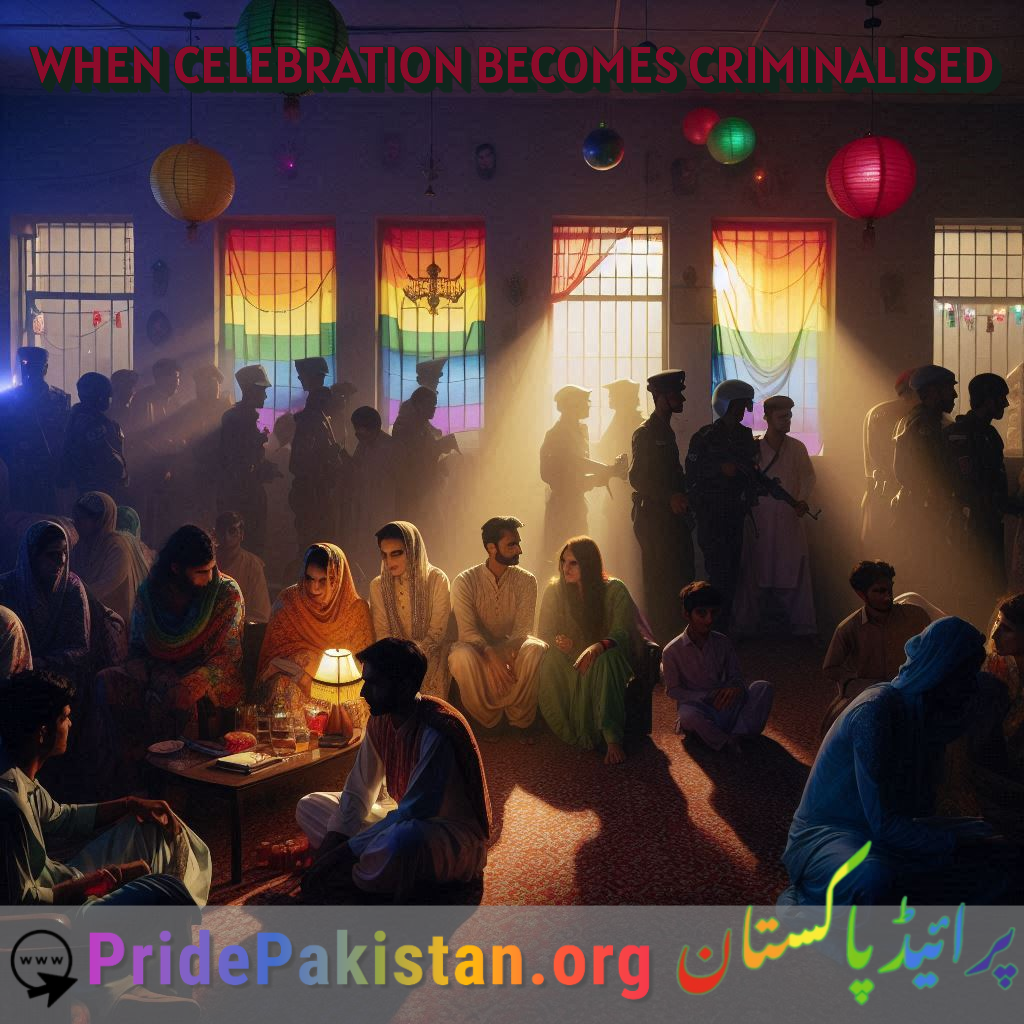
    In August 2025, Lahore police arrested transgender people and others over a private party after videos went viral — a case a magistrate threw out for total lack of evidence, noting police had recovered no obscene material at all and had followed almost no lawful procedure. The dismissal is welcome; the raid is the point. As we wrote at the time, celebration itself has been criminalised.

    The violence that never reaches a courtroom

    For most LGBTQ+ Pakistanis, the greatest danger is not the police but the people closest to them. A survey cited in the UK Home Office’s country evidence documented 956 recorded violations against LGBTQ+ people between 2016 and 2022 — verbal harassment, sexual assault, rape, and physical abuse — with three-quarters of victims being transgender, and most victims knowing their attackers.

    The patterns are grimly consistent:

    • Gay and bisexual men are entrapped through dating apps by gangs who film, rob, blackmail and sometimes kill them. Families respond to discovery not with rejection alone but with violence, forced heterosexual marriage as a “cure”, and — in tribal and rural contexts — killing in the name of honour.
    • Lesbian and bisexual women face forced marriage, domestic violence and so-called corrective rape, with even less visibility and even fewer avenues of escape.
    • Family and community “justice” — the jirga, the elders’ committee, the honour code — operates as a parallel legal system from which there is no appeal. The Swabi expulsion committee is simply this system operating in the open.

    The state does not merely fail to protect against this violence; its criminal law guarantees that victims cannot go to the police without confessing to a crime.

    Transgender Pakistanis: rights granted, then taken back

    Pakistan briefly appeared to be an exception on transgender rights. The Transgender Persons (Protection of Rights) Act 2018 recognised self-identified gender and offered anti-discrimination protections. But on 19 May 2023, the Federal Shariat Court struck down its core provisions as “un-Islamic”, ruling that gender cannot follow “self-perceived identity”. Activists are appealing, but the signal was received across the country.

    What followed has been the most violent period for trans Pakistanis in recent memory. Local organisations documented 55 killings of transgender people in Sindh province between 2022 and September 2025, including 17 in Karachi. In September 2025, three transgender women were shot dead together on the outskirts of Karachi.

    Reporting into early 2026 describes officials and violence together reversing a decade of fragile progress. Human Rights Watch’s World Report records that trans people are among the victims of honour killings by their own relatives.

    The digital wall: erasing the community online

    For a community that cannot gather in public, the internet was the only commons — and Pakistan is now walling it off. Under the Prevention of Electronic Crimes Act (PECA) 2016, more than 1.4 million URLs have been blocked, according to Freedom House’s Freedom on the Net 2025 report. In the 2023–24 financial year alone, of 109,771 URLs blocked, the majority — 55,723 — were blocked for “morality”: the administrative category under which queer life is deleted from the Pakistani internet.

    Since 2024, the state has deployed a national firewall built on imported surveillance technology — the Web Monitoring System and Lawful Intercept Management System — whose rollout has been linked to nationwide connectivity disruptions and which Pakistan’s own press describes as an opaque instrument of control.

    The practical effect for our community is simple: LGBTQ+ resources, health information and community platforms — including this organisation’s own website — are unreachable from inside Pakistan without circumvention tools that are themselves being squeezed.

    An LGBTQ+ Pakistani in 2026 is thus cut off three times over: from public space by the mob, from legal protection by Section 377, and from the digital world by the firewall.

    What the world’s own evidence says

    None of this is hidden. The UK Home Office’s November 2025 country policy note itself records the dating-app entrapment, the forced marriages, the family violence, the absence of state protection, and the reality that most gay Pakistanis conceal their identity to survive. Immigration law practitioners have publicly criticised the note’s own summary for downplaying what its underlying evidence shows — a reminder that even the governments assessing our community’s safety must be held to their own sources.

    The evidence is consistent across every serious body that has looked: the Human Dignity Trust, the ILGA World Database, OutRight International, Human Rights Watch, and the Immigration and Refugee Board of Canada. Criminalisation, family violence, police extortion, digital erasure, no protection. The record is not contested. It is only ignored.

    If you need help

    • Inside Pakistan: Prioritise your safety. Use a reputable VPN before accessing any LGBTQ+ resource, lock down social media privacy settings, and be extremely cautious with dating apps — entrapment gangs are active. Our community channels (contact details on this site) can connect you with discreet peer support.
    • If you are in danger and need to leave: Rainbow Railroad helps LGBTQI+ people escape state and community violence.
    • In the diaspora (UK): Galop supports LGBT+ victims of abuse and hate crime; Switchboard offers a listening service; Hidayah supports LGBTQI+ Muslims specifically.
    • Documentation and advocacy: Human Dignity Trust, OutRight International, ILGA Asia, and Amnesty International all document violations in Pakistan; if you can safely record what happened to you, your testimony strengthens the record on which the world judges Pakistan.

    Note: Anyone facing an immigration or protection decision should consult a qualified legal professional; nothing in this article is legal advice.

    Conclusion: the cost of being seen

    Pakistan’s persecution of its LGBTQ+ citizens does not need gallows or mass trials. It needs only what it already has: a law that makes us criminals, families licensed to punish us, police who profit from our fear, courts that undo our rights, and a firewall that deletes our voices.

    The 226 people arrested in Swabi for attending a musical show; the man sent to a psychiatric ward for asking permission to open a club; the three women shot together in Karachi; the fifty-five killed in Sindh whose names most of Pakistan will never learn — they are not exceptions to the system. They are the system.

    We publish this record because the first act of persecution is always the same: to make its victims invisible. We decline to be.

    Pride Pakistan is a community organisation supporting LGBTQI+ Pakistanis at home and in the diaspora. Sources accessed and verified 7 July 2026.

    References

    1. UK Home Office, Country Policy and Information Note — Sexual orientation and gender identity or expression, Pakistan (November 2025): gov.uk
    2. Free Movement, Concerns raised about changes to Home Office’s country evidence on Pakistan for LGBT+ people (2 January 2026): freemovement.org.uk
    3. Human Dignity Trust, Criminalisation of LGBT People in Pakistan: humandignitytrust.org
    4. Immigration and Refugee Board of Canada, Responses to Information Requests — Pakistan: irb-cisr.gc.ca
    5. Dawn, Swabi police arrest 226 people for ‘resisting raid on musical show’ (September 2025): dawn.com
    6. Dawn, Elders form body to ‘expel’ transgenders from Swabi (September 2025): dawn.com
    7. ILGA Asia, Pakistan: Targeted harassment and expulsion of transgender individuals across Khyber Pakhtunkhwa needs to stop (October 2025): ilgaasia.org
    8. NBC News, Three transgender women are shot and killed in Pakistan’s largest city (September 2025): nbcnews.com
    9. Erasing 76 Crimes, Anti-trans officials and violence reverse progress for transgender Pakistanis (3 February 2026): 76crimes.com
    10. JURIST, Pakistan Federal Shariat Court rules against landmark transgender rights legislation (May 2023): jurist.org
    11. NBC News, Pakistani trans activists to appeal Shariah court ruling (2023): nbcnews.com
    12. The Express Tribune, Gay couple arrested in Balochistan after secret ‘marriage’ (June 2015): tribune.com.pk
    13. PinkNews, Man held in mental hospital after trying to set up Pakistan gay club (10 June 2024): thepinknews.com
    14. Dawn, Case dismissed against transgender persons held for organising ‘objectionable’ party in Lahore (August 2025): dawn.com
    15. Human Rights Watch, Pakistan Province Bans Film about Trans Character (29 November 2022): hrw.org
    16. Amnesty International, Pakistan: Ban on film Joyland must be reversed immediately (November 2022): amnesty.org
    17. Freedom House, Freedom on the Net 2025: Pakistan: freedomhouse.org
    18. Dawn, Firewall confusion (editorial): dawn.com
    19. Human Rights Watch, World Report 2025: Pakistan: hrw.org
    20. ILGA World Database, LGBTI Rights in Pakistan: database.ilga.org
    21. OutRight International, Pakistan: outrightinternational.org
    22. Rainbow Railroad: rainbowrailroad.org

  • islam

    Explore Our Commitment to LGBTQ+ Inclusion in Islam

    This section shares our dedication to supporting LGBTQ+ Muslims and South Asians, highlighting our goals of promoting understanding, acceptance, and cultural awareness through empowering resources and stories.

    Explore Our Inspiring LGBTQ+ Muslim Stories

    Discover a thoughtful selection of visuals celebrating the vibrant spirit of LGBTQ+ Muslims and South Asians.

    Qasim Iqbal: Speaking Out on Islam and LGBTQI Rights in Pakistan

    in a country where LGBTQI voices are often silenced, Qasim Iqbal, a leading activist, has courageously spoken out about the realities faced by queer people in Pakistan. In this short but powerful video interview with PinkNews on Jun 4, 2020, he explains how laws, social stigma, and religious hate combine to make life unsafe for LGBTQI individuals.

    Arshad Khan: A Gay Son and His Muslim Father

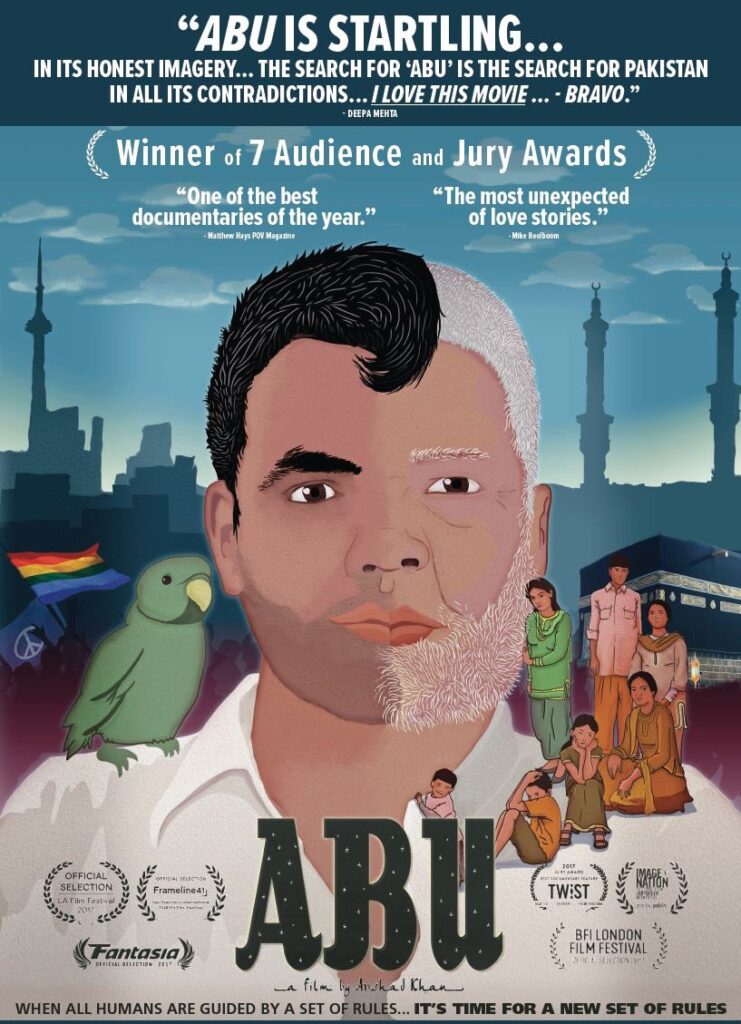
    Arshad Khan, a Pakistani-Canadian filmmaker and founder of Abu Films, has become a powerful voice in global cinema. His deeply personal work explores themes of migration, identity, sexuality, and the struggle of reconciling being gay with a devout Muslim upbringing.

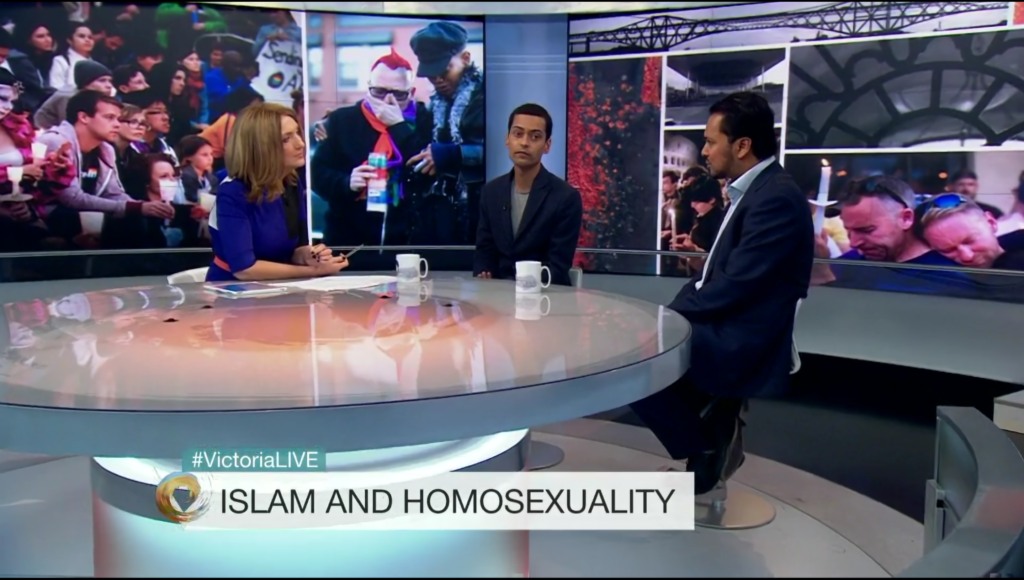
    The Victoria Derbyshire Programme, featuring Asif Quraishi (gay and Muslim) and Imam Ajmal Masroor.

    The central debate—captured by the quote “I believe you can be both gay and Muslim”—explores the diverse interpretations within our faith. Asif Quraishi argues for the Quran’s openness, while Imam Ajmal Masroor stresses the Islamic imperative for tolerance and acceptance for all people, even amidst theological disagreement.

    Discover LGBTQ+ Muslim and South Asian Resources

    Access a curated selection of cultural and educational materials fostering inclusion and acceptance.

    Inclusive Faith Dialogues

    Understand how faith and LGBTQ+ identities intersect within Muslim and South Asian communities.

    Documentaries & Media

    Discover impactful films like ‘Allah Loves Equality’ promoting awareness and empathy.

    Support Networks

    Find groups and organizations offering safe spaces and advocacy for LGBTQ+ Muslims.

    Educational Resources

    Access guides and articles designed to empower and inform your journey of acceptance.

  • Roles & Dynamics

    Roles & Dynamics

    Roles & Dynamics

    کردار اور جنسی حرکیات

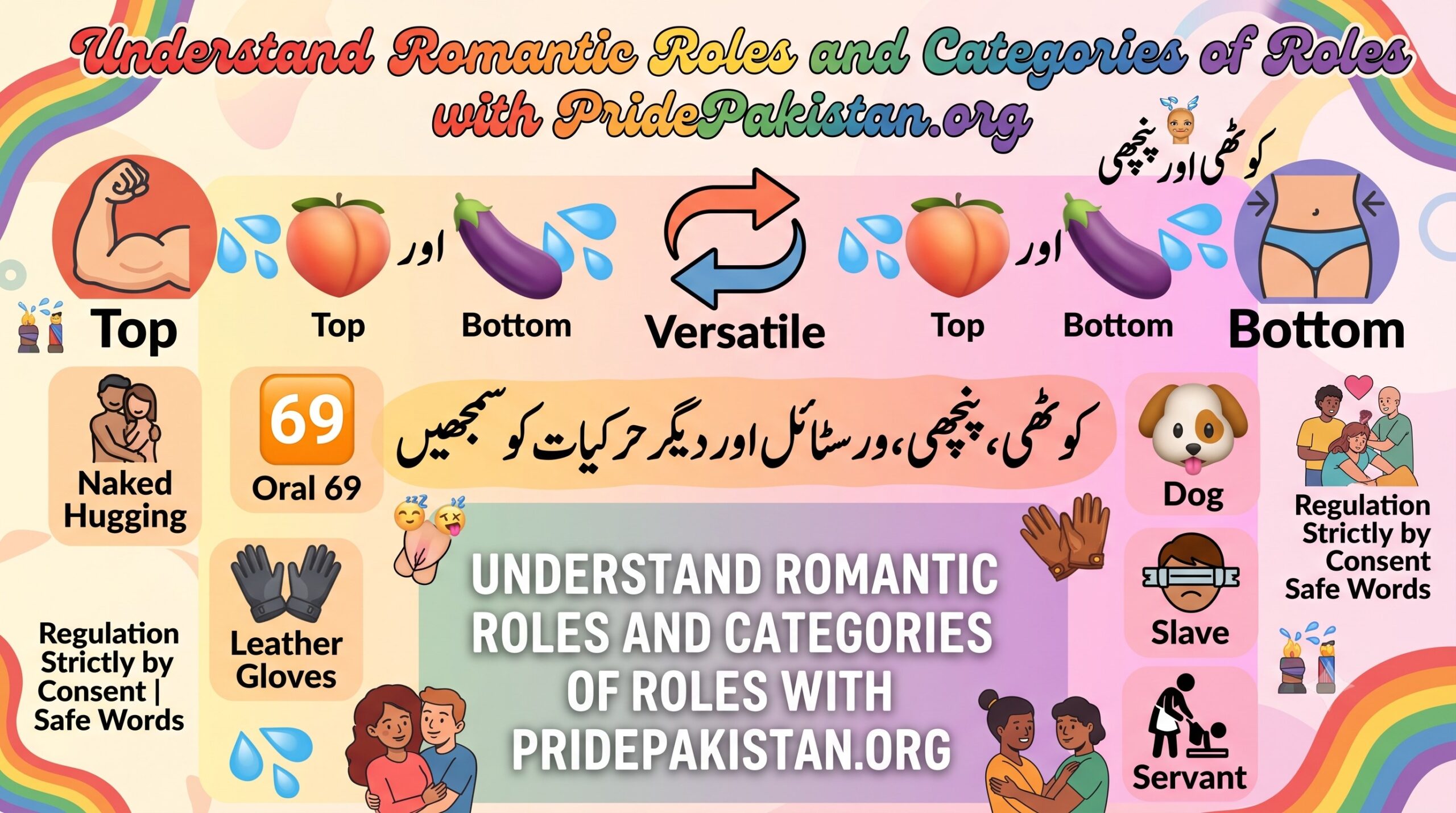
    Human intimacy is diverse, fluid, and deeply personal. Within the queer community, individuals establish specific roles, preferences, and boundary dynamics to navigate physical and emotional connections safely and consensually. Unfortunately, patriarchal systems often try to force these complex desires into rigid binaries, associating certain roles with dominance and others with weakness or shame.

    At PridePakistan.org, we break down these physical dynamics using clear, non-judgmental terminology. Whether exploring traditional South Asian definitions or navigating modern global subcultures, understanding these concepts ensures that every individual can communicate their desires with dignity, clarity, and absolute consent.

    اردو

    انسانی قربت متنوع، لچکدار اور گہری ذاتی ہوتی ہے۔ کوئیر برادری کے اندر، افراد جسمانی اور جذباتی تعلقات کو محفوظ اور باہمی رضامندی سے چلانے کے لیے مخصوص کردار، ترجیحات اور حدود کا تعین کرتے ہیں۔ بدقسمتی سے، پدرشاہی نظام اکثر ان پیچیدہ خواہشات کو زبردستی روایتی سانچوں میں ڈھالنے کی کوشش کرتا ہے، جس میں کچھ کرداروں کو تسلط اور دوسروں کو کمزوری یا شرم سے جوڑ دیا جاتا ہے۔

    پرائیڈ پاکستان میں ہم ان جسمانی حرکیات کو بغیر کسی تعصب کے واضح اصطلاحات کے ساتھ بیان کرتے ہیں۔ چاہے وہ جنوبی ایشیا کی روایتی تعریفیں ہوں یا جدید عالمی ثقافت، ان تصورات کو سمجھنا اس بات کو یقینی بناتا ہے کہ ہر انسان اپنی خواہشات کا اظہار وقار، وضوح اور مکمل رضامندی کے ساتھ کر سکے۔

    1. Traditional South Asian Roles / روایتی جنوبی ایشیائی کردار

    Kothi & Panthi / کوٹھی اور پنچھی

    • English: Traditional, deeply rooted South Asian concepts defining behavioral and sexual roles. A Kothi generally expresses feminine traits and prefers a receptive, nurturing, or bottom role during physical intimacy. A Panthi embodies masculine presentation and typically takes the penetrative or top role. These historical terms validate gender variance and relational roles outside Western paradigms.
    • Urdu: یہ جنوبی ایشیا کے روایتی اور گہرے تصورات ہیں جو رویے اور جنسی کرداروں کی وضاحت کرتے ہیں۔ ‘کوٹھی’ عام طور پر نسوانی خصوصیات کا اظہار کرتا ہے اور جسمانی قربت کے دوران وصول کنندہ (باٹم) کے کردار کو ترجیح دیتا ہے۔ دوسری طرف، ‘پنچھی’ مردانہ اندازِ بیان کو اپناتا ہے اور عام طور پر دخول کرنے والے (ٹاپ) کا کردار ادا کرتا ہے۔ یہ تاریخی اصطلاحات مغربی نظام سے باہر صنف اور تعلقات کی توثیق کرتی ہیں۔

    Chutu & Bundu / چُوتو اور بُنڈو

    • English: Derived directly from the regional anatomical terms Chuut and Bund, these words explicitly describe an individual who prefers or plays the bottom role during sexual intercourse, utilizing their rear for pleasure. While mainstream heterosexual digital spaces often weaponize these terms as street slurs, within the queer registry, they are accurate behavioral descriptors of sexual position preferences.
    • Urdu: یہ الفاظ براہِ راست مقامی اعضاء ‘چُھوت’ اور ‘بُنڈ’ سے ماخوذ ہیں اور واضح طور پر ایسے فرد کو بیان کرتے ہیں جو جنسی ملاپ کے دوران باٹم کے کردار کو ترجیح دیتا ہے یا خوشی کے لیے اس کا استعمال کرتا ہے۔ اگرچہ عام معاشرے کے ڈیجیٹل حلقوں میں ان الفاظ کو طعنوں کے طور پر استعمال کیا جاتا ہے، لیکن کوئیر ریکارڈ میں یہ جنسی پوزیشن کی ترجیحات کے درست عکاس ہیں۔

    2. Global & Evolving Sexual Positions / عالمی اور جدید جنسی کردار

    Top / ٹاپ

    • English: Globally defines the active or penetrative partner during sexual intercourse. It is crucial to decouple this role from biological anatomy: a transgender individual with male genitalia can comfortably play a top role, and similarly, a female or a wife in a straight or queer relationship can fulfill the top role (such as through pegging or structural dominance). Recently, many heterosexual men seeking quick sexual release on networking apps have also adopted this word to indicate they are strictly present to penetrate and satisfy themselves without emotional reciprocity.
    • Urdu: عالمی سطح پر اس سے مراد جنسی ملاپ کے دوران سرگرم یا دخول کرنے والا ساتھی ہے۔ اس کردار کو حیاتیاتی اعضاء سے الگ کر کے دیکھنا انتہائی ضروری ہے، مثال کے طور پر، مردانہ اعضاء رکھنے والا ایک ٹرانس جینڈر فرد آسانی سے ٹاپ کا کردار ادا کر سکتا ہے، اور اسی طرح، کسی سیدھے یا کوئیر تعلقات میں ایک عورت یا بیوی بھی ٹاپ کا کردار ادا کر سکتی ہے۔ حال ہی میں، بہت سے سیدھے مردوں نے بھی نیٹ ورکنگ ایپس پر فوری جنسی تسکین کے لیے اس لفظ کو اپنانا شروع کر دیا ہے تاکہ یہ ظاہر کیا جا سکے کہ وہ جذباتی تعلق کے بغیر صرف اپنی تسکین کے لیے سرگرم کردار ادا کرنے آئے ہیں۔

    Bottom / باٹم

    • English: Defines the receptive partner during physical intimacy. This role is rooted entirely in physical and emotional comfort, involving receiving penetration or focusing on receptive pleasure. It carries zero correlation to submissiveness in everyday life, as an individual can be highly powerful socially while preferring a bottom role intimately.
    • Urdu: اس سے مراد جسمانی قربت کے دوران وصول کنندہ ساتھی ہے۔ یہ کردار مکمل طور پر جسمانی اور جذباتی سکون پر مبنی ہوتا ہے، جس میں دخول قبول کرنا یا جنسی لذت حاصل کرنا شامل ہے۔ اس کا روزمرہ کی زندگی میں عاجزی یا کمتری سے کوئی تعلق نہیں ہے، کیونکہ ایک شخص سماجی طور پر انتہائی طاقتور ہو سکتا ہے جبکہ نجی زندگی میں باٹم کردار کو ترجیح دیتا ہو۔

    Versatile / ورسٹائل

    • English: Describes an individual who enjoys, adapts to, and engages in both top and bottom roles depending on the partner, context, mood, or emotional connection. It represents flexibility and the rejection of rigid positional binaries.
    • Urdu: یہ ایسے فرد کو ظاہر کرتا ہے جو اپنے ساتھی، ماحول، مزاج یا جذباتی تعلق کے لحاظ سے ٹاپ اور باٹم دونوں کرداروں سے لطف اندوز ہوتا ہے اور انہیں اپناتا ہے۔ یہ لچک اور جنسی پوزیشنوں کے سخت سانچوں کو مسترد کرنے کی علامت ہے۔

    3. Spectrums of Romance & Non-Penetrative Intimacy / رومانس اور غیر دخولی قربت کے درجات

    Intimacy is not limited to intercourse. For different people, physical and romantic connections exist at distinct levels:

    • Naked Hugging / صرف برہنہ گلے ملنا: Individuals who find profound emotional and physical validation simply by holding each other close, skin-to-skin, without progressing to genital friction.
      • Urdu: وہ افراد جو بغیر کسی جنسی ملاپ کے، صرف ایک دوسرے کو برہنہ حالت میں گلے لگا کر اور جلد سے جلد چھو کر گہرا جذباتی اور جسمانی سکون حاصل کرتے ہیں۔
    • Oral Body Love / صرف زبانی جسمانی محبت: Focuses on full-body kissing, caressing, massaging, and using the lips and tongue across non-genital parts of the partner’s anatomy to express deep affection.
      • Urdu: گہری محبت کے اظہار کے لیے اعضاءِ تناسل کے علاوہ پارٹنر کے پورے جسم کو چومنے، مساج کرنے اور ہونٹوں اور زبان کے استعمال پر توجہ مرکوز کرنا۔
    • Oral & Genital Sucking (69) / زبانی جنسی ملاپ اور چوسنا: Engaging in oral stimulation of the genitals, either sequentially or simultaneously through the classic structural position known globally as sixty-nine, maximizing mutual erotic pleasure without penetration.
      • Urdu: اعضاءِ تناسل کو زبان اور منہ کے ذریعے متحرک کرنا، چاہے وہ باری باری ہو یا ایک ہی وقت میں ایک مخصوص پوزیشن کے ذریعے کیا جائے جس میں دونوں ساتھی بیک وقت ایک دوسرے کو زبانی لذت فراہم کرتے ہیں۔

    4. Global Fetish & BDSM Concepts / عالمی فیش اور بی ڈی ایس ایم تصورات

    For Pakistani LGBTQI+ community members navigating platforms like Grindr without prior exposure to global queer spaces, terms surrounding fetishes and BDSM can feel overwhelming. Here is a clear breakdown:

    Fetish / فیش

    • English: An intense sexual attraction to a specific non-living object, a specific body part (such as feet), or a highly particular scenario. Fetishes are healthy expressions of adult desire. Some individuals prefer Outdoor Fetishes (engaging in intimacy in semi-public or natural settings for the thrill of vulnerability), while others engage in Group Fetishes (sharing erotic spaces with multiple consensual partners to break isolation).
    • Urdu: کسی مخصوص بے جان چیز، جسم کے کسی خاص حصے (جیسے پاؤں)، یا کسی خاص منظر نامے کی طرف شدید جنسی کشش محسوس کرنا۔ یہ بالغ افراد کی خواہشات کا ایک عام اظہار ہے۔ کچھ لوگ بیرونی مقامات پر جنسی عمل کو ترجیح دیتے ہیں (جیسے کسی قدرتی ماحول میں قربت حاصل کرنا)، جبکہ کچھ لوگ اجتماعی شکل میں اس کا تجربہ کرتے ہیں (جہاں متعدد رضامند ساتھی ایک ساتھ جنسی عمل کا حصہ بنتے ہیں)۔

    BDSM Overview / بی ڈی ایس ایم کا جائزہ

    • English: An acronym standing for Bondage & Discipline, Dominance & Submission, Sadism & Masochism. It revolves entirely around structured, pre-negotiated boundaries, strict consent, and safe words. It is an exploration of power dynamics, trust, and physical sensations.
    • Urdu: یہ اصطلاح مختلف جنسی ترجیحات کا مجموعہ ہے جس میں رسیوں سے باندھنا، نظم و ضبط، تسلط قائم کرنا، دوسرے کے سامنے ہتھیار ڈالنا، اور جسمانی یا جذباتی احساسات کے ذریعے لذت حاصل کرنا شامل ہے۔ یہ مکمل طور پر پہلے سے طے شدہ حدود، سخت رضامندی اور حفاظتی الفاظ کے گرد گھومتا ہے، جہاں طاقت اور اعتماد کا تجربہ کیا جاتا ہے۔

    Sub-Identity Terms: Slave, Dog, and Servant / غلام، کتا اور نوکر

    • English: Within BDSM subcultures, these words do not mean literal human rights abuses or forced labor. They are psychological roles adopted voluntarily during consensual roleplay. A Slave or Servant willingly gives up control to a dominant partner for erotic pleasure, serving their desires inside a safe boundaries framework. A Dog roleplay refers to puppy play, where an individual finds comfort, stress-relief, and erotic satisfaction by adopting the submissive, playful traits of an animal.
    • Urdu: ان اصطلاحات کا مطلب حقیقی انسانی حقوق کی خلاف ورزی یا زبردستی مزدوری نہیں ہے۔ یہ نفسیاتی کردار ہیں جو باہمی رضامندی سے کھیل کے دوران اپنائے جاتے ہیں۔ ایک ‘غلام’ یا ‘نوکر’ جنسی لذت کے لیے رضاکارانہ طور پر اپنا کنٹرول ایک غالب ساتھی کے حوالے کر دیتا ہے۔ ‘کتا’ یا جانور کا کردار اپنانے سے مراد وہ کھیل ہے جہاں ایک فرد کسی وفادار جانور کی خصوصیات اپنا کر ذہنی سکون، تناؤ سے نجات اور جنسی تسکین حاصل کرتا ہے۔

    Latex / لیٹیکس

    • English: A specific fetish involving wearing skin-tight clothing made of rubber or latex material. It provides an intense tactile sensation, restricts the skin, and creates a visual aesthetic of absolute containment, highly popular in global queer leather and fetish communities.
    • Urdu: یہ ایک مخصوص لباس کا شوق ہے جس میں ربڑ یا چمکیلے مادے سے بنے ہوئے چست کپڑے پہنے جاتے ہیں۔ یہ جسم کو ایک خاص لمس فراہم کرتا ہے، جلد کو جکڑتا ہے، اور عالمی کوئیر برادری میں جنسی تسکین کے ایک خاص انداز کے طور پر مقبول ہے۔

    Practical Context Examples / عملی زندگی سے مثالیں

    Context 1: Deconstructing “Top” and Anatomy

    • English Misconception: Online users assume: “If a trans woman has male parts, she must act as a man in bed.”
    • Pride Pakistan Correction: Identity does not dictate sexual positioning. A trans woman can play a top role while remaining entirely a woman, just as a cisgender straight woman can take the active top position with her husband.
    • Urdu Example: عام طور پر لوگ سمجھتے ہیں کہ اگر کوئی ٹرانس خاتون مردانہ اعضاء رکھتی ہے تو وہ جنسی عمل میں مرد کا ہی کردار ادا کرے گی۔ لیکن ہم واضح کرتے ہیں کہ پہچان جنسی پوزیشن کا تعین نہیں کرتی۔ ایک ٹرانس خاتون مکمل طور پر عورت رہتے ہوئے بھی ٹاپ کا کردار ادا کر سکتی ہے، بالکل ویسے ہی جیسے ایک عام سیدھی عورت اپنے شوہر کے ساتھ سرگرم کردار ادا کر سکتی ہے۔

    Context 2: Understanding Grinder/BDSM Roles Safely

    • English Misconception: A new user sees “Looking for a sub slave” on an app and worries it refers to human trafficking.
    • Pride Pakistan Correction: Within the digital queer framework, this is a call for a consensual, submissive partner interested in power-play roleplay, regulated strictly by safe words.
    • Urdu Example: جب کوئی نیا صارف کسی ایپ پر یہ دیکھتا ہے کہ کسی کو ‘غلام ساتھی’ کی تلاش ہے، تو وہ پریشان ہو سکتا ہے کہ یہ کوئی جرم ہے۔ لیکن ہم واضح کرتے ہیں کہ کوئیر نیٹ ورک کے اندر اس سے مراد ایک ایسا رضامند ساتھی ہے جو کھیل کے طور پر کچھ وقت کے لیے اپنا کنٹرول دوسرے کو دینے میں جنسی دلچسپی رکھتا ہو۔

  • Under the Lens: State Violence and the LGBTQI+ Struggle in Pakistan

    Under the Lens: State Violence and the LGBTQI+ Struggle in Pakistan

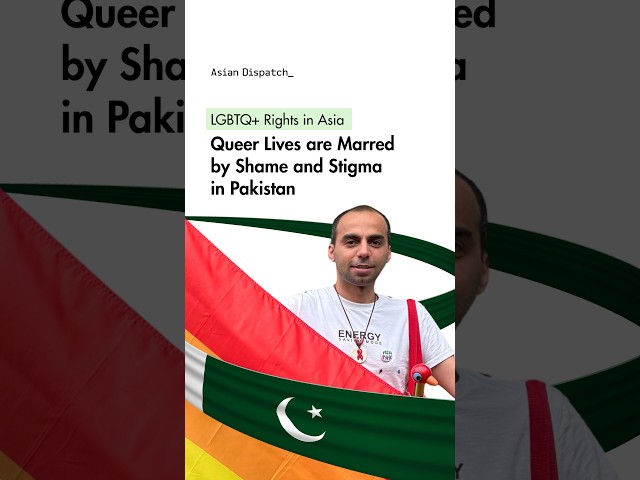
    A Critical Journalism Initiative by Asian Dispatch

    We extend our deepest gratitude and professional credit to Asian Dispatch, a premier independent journalistic platform dedicated to uncovering overlooked human rights narratives across Asia. Their team has produced a groundbreaking, deeply necessary video investigative series exploring the destructive legacy of colonial-era laws, specifically Section 377. By providing a platform for raw, uncensored testimonies, Asian Dispatch has highlighted the systemic challenges faced by marginalized communities in South Asia, breaking international silences on structural oppression.

    At PridePakistan.org, our mission has always been to document the real, unvarnished pain of our community and challenge state-sponsored erasure with hard evidence. In this vital collaboration, our founder, Ali Raza Khan, alongside community members like Sumair, stepped forward to outline how colonial legal frameworks have evolved into modern systems of digital terrorism, illegal extortion, and forced institutionalization.

    Video Transcript & Accessibility Hub

    For differently-abled individuals, visually impaired community members using screen readers, or those unable to view the video content, we have provided the full, verbatim text script below.

    Narrator / Text on Screen: That’s a clip from the 2022 Pakistani film Joyland. The film explores the issues of gender and sexuality in Pakistan—subjects that are still considered taboo. It depicts the societal discrimination that the queer community faces on a daily basis in the country. The film was initially banned for showing “objectionable content” but was eventually passed with cuts. What was shown on the big screen is the reality of the queer community in Pakistan.

    Ali Raza Khan, an activist who works to support the LGBTQ+ community in Pakistan, says that before Section 377, queer love and gender diversity existed openly in the country’s cultural and spiritual traditions.

    Ali Raza Khan: “Before the British arrived with their penal codes, our society deeply understood and accepted homosexual love as a valid emotional and spiritual reality. Look at the famous 16th-century Sufi poet Shah Hussain and his male lover Madhu Lal. Two men whose deep devotional and romantic bond was so celebrated that they are buried together in a single shrine in Lahore. Look at Bulleh Shah, who broke all gender norms, writing intense poetry of same-sex longing. Colonial rule destroyed this understanding.”

    Narrator / Text on Screen: Under British rule, Section 377 criminalized same-sex relations and its legacy continued shaping public morality and social attitudes in Pakistan even after independence. But the impact of Section 377 goes beyond the law itself. Ali says digital surveillance, censorship, and police crackdowns have pushed queer communities away from public spaces.

    Ali Raza Khan: “The modern state digital censorship apparatus did not stop at blocking pornographic websites; they systematically expanded their plan to target dating applications and more recently clamped down heavily on VPN services to completely cut off our community’s access to the outside world. State authorities maintain an active, malicious presence directly inside gay community platforms, hiding behind fake profiles exclusively to entrap, stalk, and target gay individuals.”

    Narrator / Text on Screen: Ali says that the authorities often rely on morality laws to arrest individuals.

    Ali Raza Khan: “This crackdown doesn’t just hit large organized networks like Naz; authorities actively hunt down all independent groups and private individuals attempting to coordinate underground gatherings across Pakistan. Take the horrific, definitive example of Preetum Giani in Abbottabad. He attempted to legally register an indoor safe space and a gay club—an act that violated no written statute. Yet, the state authorities arrested him and forcefully committed him to a mental health asylum in Peshawar.”

    Narrator / Text on Screen: In 2024, 75-year-old Giani was arrested and sent to a mental asylum. His whereabouts remain unknown. For many queer Pakistanis, this fear exists not just in law or online spaces, but even inside their homes and workplaces. Sumair, a queer person from Karachi, says everyday life itself becomes a struggle.

    Sumair: “LGBTQI+ people face teasing, insults, harassment, and sometimes physical violence. People judge them because of their appearance and identity. At home, family members often taunt them, emotionally harass them, and even tell them to leave the house—they make them feel like they do not belong. Many people also connect LGBTQI+ identity with religion in a negative way and say it is wrong in Islam.”

    Narrator / Text on Screen: Sumair also highlights the lack of legal and institutional support for the community in the country, which leaves them vulnerable to abuse and exploitation. However, community-led organizations work silently and in hiding to create support systems, especially around mental health.

    Sumair: “I connected with a local organization. He is making a safe space and working… first of all on mental health because all LGBTQI+ people are suffering from mental health situations like trauma, stress, and emotional struggling. They have therapists and they arrange many sessions about mental health, and I am a part of this organization and these mental health trainings also.”

    Narrator / Text on Screen: But even within the broader queer movement, divisions remain. Ali says transgender groups are often forced to publicly distance themselves from the larger LGBTQ+ spectrum for survival.

    Ali Raza Khan: “If transgender activists publicly associate with gay, lesbian, and bisexual groups, their own fragile legal protections are completely stripped away by the right-wing extremists. They are forced to refuse any public association with the broader spectrum purely as a desperate survival tactic. This state-crafted polarization has made it impossible for intersectional leaders to survive.”

    Narrator / Text on Screen: Several other organizations that Asian Dispatch spoke to relayed this fear. And despite criminalization, censorship, violence, and isolation, queer Pakistanis continue to search for dignity, community, and the right to exist freely.

    Sumair: “I want at least basic human rights for everyone. Every person deserves the right to live safely and with dignity.”

    Watch the Full Investigation

    To see the full visual reporting, analytical graphics, and cinematic presentation prepared by the Asian Dispatch team, watch the official release here:

    https://www.instagram.com/p/DZMrTXix3Wn

  • District-by-District Breakdown: Mapping the LGBTQI+ Population Across Pakistan

    District-by-District Breakdown: Mapping the LGBTQI+ Population Across Pakistan

    Introduction: No Longer Invisible

    For generations, state narratives and cultural conditioning have attempted to relegate sexual and gender minorities in Pakistan to complete oblivion. When numbers are spoken about, they are either severely understated by state figures or blown out of proportion by internet rumors. At PridePakistan.org, we believe that real data is the ultimate shield against erasure and stigma.

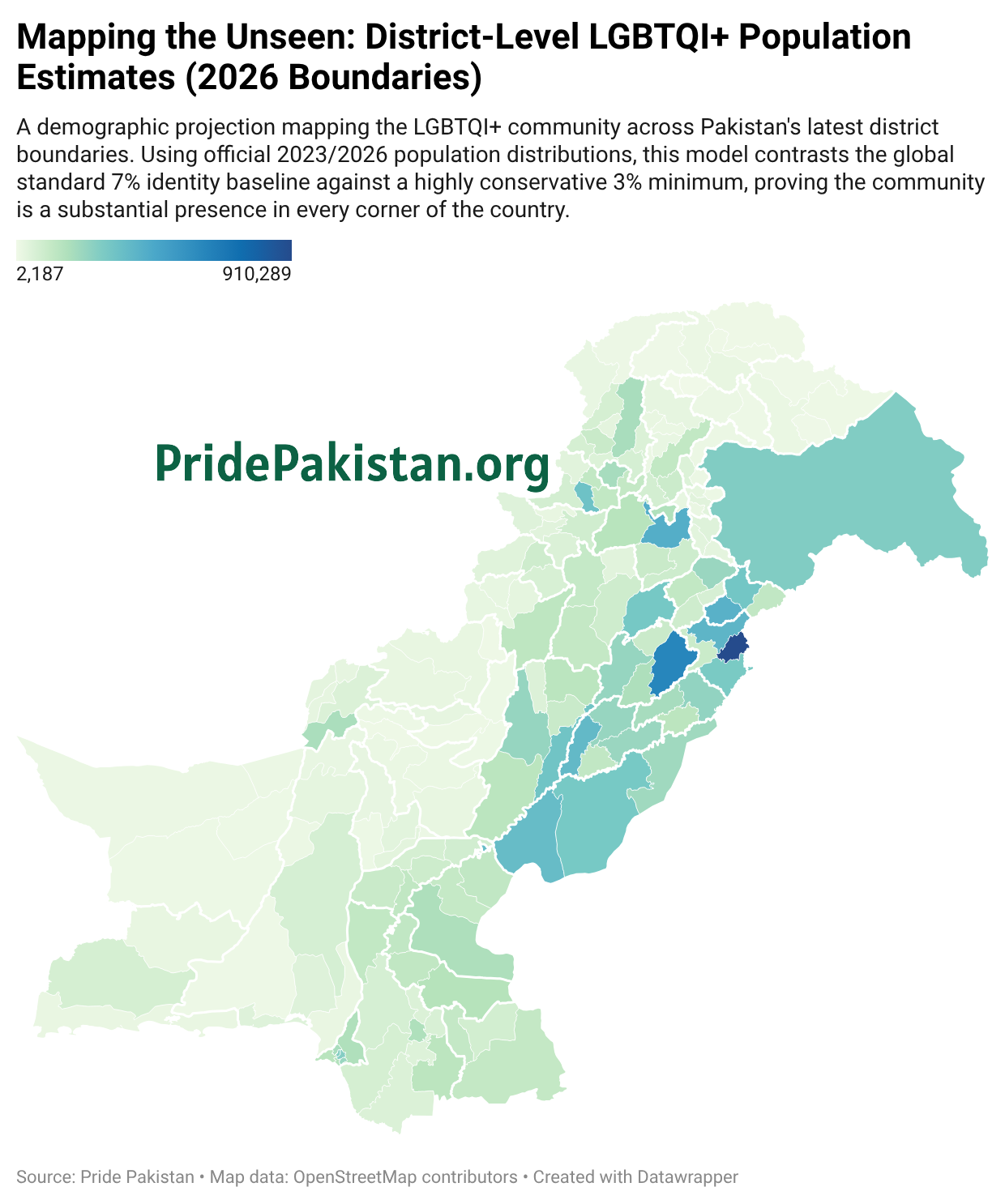
    By utilizing our newly structured demographic projection model—anchored upon a standard, scientifically validated 7% population multiplier and a conservative 3% public health floor—we have successfully mapped out our community across all regions. Below is the full, comprehensive territorial distribution tracking the millions of queer individuals living across every corner of Pakistan.

    Regional Breakdown & District Registries Included in Our Data

    To ensure absolute structural accuracy, our dataset maps the community across every administrative zone based on Pakistan’s latest 2026 administrative boundaries. Every single district and territory is actively mapped within our data network.

    1. Punjab Province

    Punjab holds the largest share of the nationwide demographic distribution. Major urban centers like Lahore, Faisalabad, Rawalpindi, Multan, and Gujranwala house hundreds of thousands of queer individuals. Our data covers every administrative layout, including:

    • Attock, Bahawalnagar, Bahawalpur, Bhakkar, Chakwal, Chiniot, Dera Ghazi Khan, Faisalabad, Gujranwala, Gujrat, Hafizabad, Jhang, Jhelum, Kasur, Khanewal, Khushab, Kot Addu, Lahore, Layyah, Lodhran, Mandi Bahauddin, Mianwali, Multan, Muzaffargarh, Murree, Narowal, Nankana Sahib, Okara, Pakpattan, Rahim Yar Khan, Rajanpur, Rawalpindi, Sahiwal, Sargodha, Sheikhupura, Sialkot, Talagang, Toba Tek Singh, Taunsa, Vehari, and Wazirabad.

    2. Sindh Province

    In Sindh, the metropolitan density of Karachi presents the most substantial regional concentration of the community across its diverse municipal districts. Along with key cities like Hyderabad and Sukkur, the mapped registry includes:

    • Badin, Dadu, Ghotki, Hyderabad, Jacobabad, Jamshoro, Karachi Central, Karachi East, Karachi South, Karachi West, Korangi, Malir, Keamari, Kashmore, Khairpur, Larkana, Matiari, Mirpur Khas, Naushahro Feroze, Kambar Shahdad Kot, Sanghar, Shikarpur, Sujawal, Sukkur, Tando Allahyar, Tando Muhammad Khan, Tharparkar, Thatta, Umer Kot, and Shaheed Benazirabad.

    3. Khyber Pakhtunkhwa (KPK) Province

    From the provincial capital of Peshawar to the northern valley networks like Swat and Mardan, our data encompasses the entire trans-and-queer topography of the region, including all newly integrated tribal subdivisions:

    • Abbottabad, Bannu, Batagram, Buner, Charsadda, Central Dir, Dera Ismail Khan, Hangu, Haripur, Karak, Kohat, Lakki Marwat, Lower Dir, Malakand, Mansehra, Mardan, Nowshera, Peshawar, Shangla, Swabi, Swat, Tank, Upper Dir, Torghar, Khyber, Mohmand, Bajaur, Kurram, Orakzai, North Waziristan, Lower South Waziristan, Upper South Waziristan, Lower Chitral, Upper Chitral, Upper Kohistan, Lower Kohistan, and Kolai Palas Kohistan.

    4. Balochistan Province

    Balochistan’s vast geography is mapped completely, tracking populations from the provincial hub of Quetta to coastal spaces like Gwadar and Kech:

    • Awaran, Barkhan, Chagai, Chaman, Dera Bugti, Gwadar, Harnai, Jaffarabad, Jhal Magsi, Kalat, Kech, Kharan, Khuzdar, Killa Abdullah, Killa Saifullah, Kohlu, Lasbela, Loralai, Mastung, Musakhel, Nasirabad, Nushki, Panjgur, Pishin, Quetta, Sherani, Sibi, Sohbatpur, Washuk, Zhob, Ziarat, Duki, Surab, Hub, and Kachhi.

    5. Federal Capital & Border Territories

    Our interactive matrix maps the Islamabad Capital Territory (ICT) as a distinct entity, alongside the complete territorial boundaries of Azad Jammu & Kashmir (AJK) and Gilgit-Baltistan (GB), ensuring no region is left blank:

    • Islamabad, Gilgit, Skardu, Diamer, Ghizer, Astore, Hunza, Nagar, Shigar, Kharmang, Ghanche, Darel, Gupis-Yasin, Tangir, Muzaffarabad, Mirpur, Bhimber, Kotli, Poonch, Bagh, Sudhnati, Neelum, Haveli, Hattian Bala, Jhelum Valley, and Kashmir.

    Conclusion

    By viewing the interactive map on our platform, researchers and community members can see the quantitative truth of our existence. We are a massive, vibrant element of every single district in Pakistan, hidden only by the necessity for safety.

    تعارف: اب کوئی پوشیدہ نہیں

    نسلوں سے، ریاستی بیانیے اور سماجی تعصبات نے پاکستان میں جنسی اور صنفی اقلیتوں کو مکمل طور پر نظر انداز کرنے کی کوشش کی ہے۔ جب بھی اعداد و شمار کی بات کی جاتی ہے، تو یا تو ریاستی اداروں کی طرف سے انہیں انتہائی کم دکھایا جاتا ہے یا پھر انٹرنیٹ پر افواہوں کے ذریعے مسخ کیا جاتا ہے۔ PridePakistan.org پر ہمارا ماننا ہے کہ حقیقی ڈیٹا ہی مٹائے جانے اور تعصب کے خلاف ہمارا سب سے بڑا ہتھیار ہے۔

    اپنے نئے سائنسی ماڈل (7% معیاری شرح اور 3% کم ترین پبلک ہیلتھ بیس لائن) کے ذریعے، ہم نے پاکستان کے تمام خطوں کا تفصیلی نقشہ تیار کیا ہے۔ ذیل میں پاکستان کے ہر کونے میں رہنے والے لاکھوں کوئیر افراد کے اعداد و شمار کا مکمل علاقائی جائزہ پیش کیا گیا ہے۔

    علاقائی جائزہ اور ضلعی فہرستیں

    مکمل سائنسی درستگی کو یقینی بنانے کے لیے، ہمارے ڈیٹا میں پاکستان کی جدید ترین 2026 کی ضلعی حدود کے مطابق ہر خطے کو شامل کیا گیا ہے۔ ہمارے ڈیٹا نیٹ ورک میں ایک بھی ضلع یا علاقہ چھٹ چھوٹ نہیں پایا۔

    ۔ صوبہ پنجاب

    ملک بھر میں آبادی کی تقسیم کے لحاظ سے پنجاب کا حصہ سب سے بڑا ہے۔ لاہور، فیصل آباد، راولپنڈی، ملتان، اور گوجرانوالہ جیسے بڑے شہری مراکز میں لاکھوں کوئیر افراد رہائش پذیر ہیں۔ ہماری ضلعی فہرست میں یہ تمام اضلاع شامل ہیں:

    • اٹک، بہاولنگر، بہاولپور، بھکر، چکوال، چنیوٹ، ڈیرہ غازی خان، فیصل آباد، گوجرانوالہ، گجرات، حافظ آباد، جھنگ، جہلم، قصور، خانیوال، خوشاب، کوٹ ادو، لاہور، لیہ، لودھراں، منڈی بہاؤالدین، میانوالی، ملتان، مظفر گڑھ، مری، نارووال، ننکانہ صاحب، اوکاڑہ، پاکپتن، رحیم یار خان، راجن پور، راولپنڈی، ساہیوال، سرگودھا، شیخوپورہ، سیالکوٹ، تلہ گنگ، ٹوبہ ٹیک سنگھ، تونسہ، وہاڑی، اور وزیر آباد۔

    ۔ صوبہ سندھ

    سندھ میں، کراچی کے مختلف اضلاع میں کمیونٹی کی سب سے بڑی تعداد موجود ہے۔ حیدرآباد اور سکھر جیسے اہم شہروں سمیت، نقشے میں درج اضلاع یہ ہیں:

    • بدین، دادو، گھوٹکی، حیدرآباد، جیکب آباد، جامشورو، کراچی وسطی، کراچی شرقی، کراچی جنوبی، کراچی غربی، کورنگی، ملیر، کیماڑی، کشمور، خیرپور، لاڑکانہ، مٹیاری، میرپور خاص، نوشہرو فیروز، قمبر شہداد کوٹ، سانگھڑ، شکارپور، سجاول، سکھر، ٹنڈو الہ یار، ٹنڈو محمد خان، تھرپارکر، ٹھٹہ، عمر کوٹ، اور شہید بینظیر آباد۔

    ۔ صوبہ خیبر پختونخوا (KPK)

    صوبائی دارالحکومت پشاور سے لے کر سوات اور مردان جیسے شمالی اضلاع تک، ہمارے ڈیٹا میں تمام نئے شامل ہونے والے قبائلی اضلاع سمیت پورا خطہ شامل ہے:

    • ایبٹ آباد، بنوں، بٹگرام، بونیر، چارسدہ، سینٹرل دیر، ڈیرہ اسماعیل خان، ہنگو، ہری پور، کرک، کوہاٹ، لکی مروت، لوئر دیر، مالاکنڈ، مانسہرہ، مردان، نوشہرہ، پشاور، شانگلہ، صوابی، سوات، ٹینک، اپر دیر، تورغر، خیبر، مہمند، باجوڑ، کرم، اورکزئی، شمالی وزیرستان، لوئر جنوبی وزیرستان، اپر جنوبی وزیرستان، لوئر چترال، اپر چترال، اپر کوہستان، لوئر کوہستان، اور کولئی پلاس کوہستان۔

    ۔ صوبہ بلوچستان

    بلوچستان کے وسیع و عریض جغرافیے کا مکمل احاطہ کیا گیا ہے، جس میں صوبائی مرکز کوئٹہ سے لے کر گوادر اور کیچ جیسے ساحلی علاقے شامل ہیں:

    • آواران، بارکھان، چاغی، چمن، ڈیرہ بگٹی، گوادر، ہرنائی، جعفرآباد، جھل مگسی، قلات، کیچ، خاران، خضدار، قلعہ عبداللہ، قلعہ سیف اللہ، کوہلو، لسبیلہ، لورالائی، مستونگ، موسیٰ خیل، نصیرآباد، نوشکی، پنجگور، پشین، کوئٹہ، شیرانی، سبی، صحبت پور، واشک، ژوب، زیارت، دوکی، سوراب، حب، اور کچھی۔

    5۔ وفاقی دارالحکومت اور علاقہ جات

    ہمارے لائیو ڈیٹا میٹرکس میں اسلام آباد (ICT) کے ساتھ ساتھ آزاد جموں و کشمیر (AJK) اور گلگت بلتستان (GB) کے تمام اضلاع کو مکمل طور پر شامل کیا گیا ہے:

    • اسلام آباد، گلگت، اسکردو، دیامر، غذر، استور، ہنزہ، نگر، شگر، کھرمنگ، غانچے، ڈاریل، گوپس یاسین، تانگیر، مظفرآباد، میرپور، بھمبر، کوٹلی، پونچھ، باغ، سدھنوتی، نیلم، حویلی، ہٹیاں بالا، اور جہلم ویلی۔

    نتیجہ

    ہماری ویب سائٹ پر لائیو نقشہ دیکھ کر آپ خود حقیقت کا اندازہ لگا سکتے ہیں۔ ہم پاکستان کے ہر ایک ضلع کا حصہ ہیں، اور ہماری موجودگی کو کوئی جھٹلا نہیں سکتا۔

    Explore the Live Interactive Map

    Our data maps the community across all four provinces, the federal capital, and regional territories. Hover over your district below to see the standard demographic estimates and conservative baseline ranges of our community members living there.

  • LGBT Population in Pakistan: Data, Methodology, and Provincial Statistics

    LGBT Population in Pakistan: Data, Methodology, and Provincial Statistics

    Introduction: Demystifying the Numbers

    When analyzing the LGBT population in Pakistan, a deep informational vacuum exists. Because official state trackers like the Pakistan Bureau of Statistics (PBS) restrict gender non-conforming variables strictly to a minimal tracking of the transgender community, finding reliable statistics on sexual orientation and gender identity can be extremely difficult. This lack of data often leads to intense online speculation, myths, or exaggerated rumors.

    Following rigorous demographic tracking and standard public health estimation methods, PridePakistan.org has developed the first comprehensive, district-by-district population projection model for the country. This study moves away from internet rumors and utilizes proven scientific frameworks to look at the real numbers.

    The Science: Is This Data Scientifically Verifiable?

    In public health and sociology, when actual national census data on marginalized or criminalized communities is missing, demographers rely on statistical extrapolation.

    The 7% Standard Identity Baseline

    Decades of independent, comprehensive demographic peer-reviewed research conducted across diverse continents—compiled by institutions like the Kinsey Institute and the Williams Institute—consistently reveal that sexual and gender minorities safely constitute between 5% to 10% of any given human population. This range remains stable regardless of local geographic boundaries, governance structures, or social systems.

    To create our model, PridePakistan.org applied a standard, realistic 7% demographic multiplier to Pakistan’s total 2023 National Digital Census population (which stands at approximately 241.5 million people). This yields a scientifically defensible national baseline estimate of 16.9 million LGBTQI+ individuals across the country.

    The 3% Conservative Minimum Range

    To account for absolute mathematical caution and handle skeptics, our dataset concurrently provides a 3% absolute minimum baseline. Even at this exceptionally narrow margin, the statistics demonstrate that queer individuals constitute a substantial and undeniable percentage of every administrative block in the country.

    National and Provincial Population Breakdown

    Based on the 7% standard identity multiplier and the 3% conservative threshold applied directly to the latest state data, here is the official breakdown of the estimated LGBTQI+ population by administrative zone:

    Province / TerritoryOfficial 2023 Census PopulationEstimated LGBTQI+ Population (7% Standard)Conservative Minimum Range (3% Floor)
    Punjab127,688,9228,938,2243,830,667
    Sindh55,696,1473,898,7301,670,884
    Khyber Pakhtunkhwa40,856,0972,859,9261,225,682
    Balochistan14,894,4021,042,608446,832
    Islamabad Capital Territory2,363,863165,47070,915
    Azad Jammu & Kashmir (AJK)~4,000,000280,000120,000
    Gilgit-Baltistan (GB)~1,500,000105,00045,000
    TOTAL NATIONWIDE ESTIMATE~249,500,000~17,289,958~7,410,000

    Why This Data Matters

    In an environment where state policy enforces invisibility, recording our own history is a necessity. This project proves that queer individuals are not an isolated anomaly or a tiny fringe element; they are millions of citizens living across every province, federal territory, and rural union council in Pakistan.

    By grounding these numbers in clear, international demographic formulas rather than social media speculation, this dataset serves as a resource for human rights defenders, researchers, and public health advocates working toward safe, inclusive futures.

    Explore the Live Interactive Map

    Our data maps the community across all four provinces, the federal capital, and regional territories. Hover over your district below to see the standard demographic estimates and conservative baseline ranges of our community members living there

  • Mapping the Reality of Pakistan-LGBTQI Population

    Mapping the Reality of Pakistan-LGBTQI Population

    The Spark: Why We Refuse to Let Stigma Dictate the Narrative

    Recently, a viral video interview featuring transgender activist Surkhina (Hina Baloch) sparked an intense, highly polarized storm across Pakistani social media platforms. In a provocative taunt aimed at challenging the country’s deep-rooted hypocrisy, Surkhina claimed that “80% of Pakistan is gay.” While the statement was clearly delivered to expose the massive, open secrets of hidden sexual orientations suppressed under the weight of compulsory heterosexuality, the mainstream narrative immediately weaponized it. Right-wing extremist groups and homophobic commentators jumped on this hyperbole, using it to fuel moral panic, delegitimize human rights advocacy, and spread toxic misinformation online.

    At PridePakistan.org, we realized that in the complete absence of reliable, transparent, and safe tracking from state institutions, the vacuum is filled either by exaggerated claims or total erasure. The state tells the world we do not exist; extremists claim we are an ideological contagion. We decided it was time to provide the real, scientifically verifiable data. Today, we are proud to launch Pakistan’s first interactive, district-by-district LGBTQI+ population map.

    The Scientific Baseline: How We Quantify the Invisible

    How do you map an underground community facing structural state terrorism, arbitrary cyber-raids under PECA laws, and forced institutionalization? You turn to standard public health methodologies and demographic science.

    To counter both conservative undercounts and viral internet rumors, we applied a globally recognized statistical extrapolation model across Pakistan’s latest 2026 administrative district boundaries:

    1. The Standard Identity Baseline (7%): Decades of independent demographic documentation compiled by global entities (such as the Kinsey Institute and the Williams Institute) demonstrate that sexual and gender minorities consistently constitute between 5% to 10% of any given human population. Our map utilizes a standard, realistic 7% multiplier applied against the official national census counts. This places Pakistan’s actual LGBTQI+ population at an estimated 16.8 million individuals.
    2. The Conservative Minimum (3%): To maintain absolute scientific defense against skeptics, our interactive data features a local hover tooltip displaying a 3% absolute minimum baseline. Even at this highly restrictive margin, the sheer volume proves that queer people are not an isolated anomaly—they are thousands of citizens breathing in every local neighborhood.

    Explore the Live Interactive Map

    Our data maps the community across all four provinces, the federal capital, and regional territories. Hover over your district below to see the standard demographic estimates and conservative baseline ranges of our community members living there.

    The Power of Data in an Era of Erasure

    This map is more than just raw data; it is an act of digital resistance. When state agencies like the NCCIA actively infiltrate queer networking applications, kidnap adult consenting individuals for extortion, and shut down reproductive healthcare organizations like Rutgers Pakistan, numbers become our shield.

    When you see that a single district like Lahore holds nearly a million queer individuals, or that Karachi Central houses over a quarter of a million, the narrative changes. We are your doctors, your teachers, your siblings, and your children. We are woven into the very fabric of this land, from the historical shrines of Madho Lal Hussain to the modern digital frontier. We are here, we are millions, and we will no longer be erased by the state or misrepresented by rumors.