The Spark: Why We Refuse to Let Stigma Dictate the Narrative
Recently, a viral video interview featuring transgender activist Surkhina (Hina Baloch) sparked an intense, highly polarized storm across Pakistani social media platforms. In a provocative taunt aimed at challenging the country’s deep-rooted hypocrisy, Surkhina claimed that “80% of Pakistan is gay.” While the statement was clearly delivered to expose the massive, open secrets of hidden sexual orientations suppressed under the weight of compulsory heterosexuality, the mainstream narrative immediately weaponized it. Right-wing extremist groups and homophobic commentators jumped on this hyperbole, using it to fuel moral panic, delegitimize human rights advocacy, and spread toxic misinformation online.
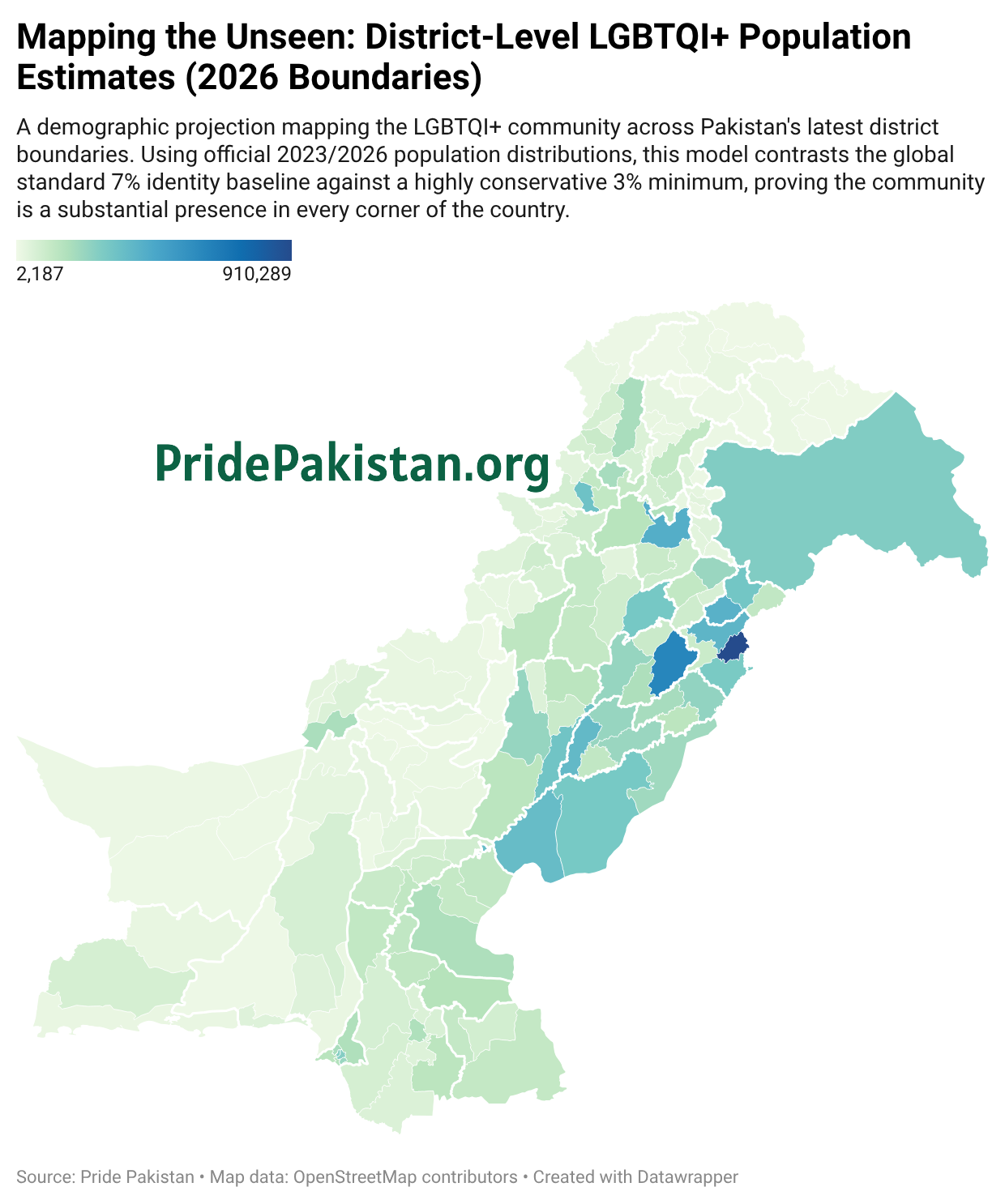
At PridePakistan.org, we realized that in the complete absence of reliable, transparent, and safe tracking from state institutions, the vacuum is filled either by exaggerated claims or total erasure. The state tells the world we do not exist; extremists claim we are an ideological contagion. We decided it was time to provide the real, scientifically verifiable data. Today, we are proud to launch Pakistan’s first interactive, district-by-district LGBTQI+ population map.
The Scientific Baseline: How We Quantify the Invisible
How do you map an underground community facing structural state terrorism, arbitrary cyber-raids under PECA laws, and forced institutionalization? You turn to standard public health methodologies and demographic science.
To counter both conservative undercounts and viral internet rumors, we applied a globally recognized statistical extrapolation model across Pakistan’s latest 2026 administrative district boundaries:
- The Standard Identity Baseline (7%): Decades of independent demographic documentation compiled by global entities (such as the Kinsey Institute and the Williams Institute) demonstrate that sexual and gender minorities consistently constitute between 5% to 10% of any given human population. Our map utilizes a standard, realistic 7% multiplier applied against the official national census counts. This places Pakistan’s actual LGBTQI+ population at an estimated 16.8 million individuals.
- The Conservative Minimum (3%): To maintain absolute scientific defense against skeptics, our interactive data features a local hover tooltip displaying a 3% absolute minimum baseline. Even at this highly restrictive margin, the sheer volume proves that queer people are not an isolated anomaly—they are thousands of citizens breathing in every local neighborhood.
Explore the Live Interactive Map
Our data maps the community across all four provinces, the federal capital, and regional territories. Hover over your district below to see the standard demographic estimates and conservative baseline ranges of our community members living there.
The Power of Data in an Era of Erasure
This map is more than just raw data; it is an act of digital resistance. When state agencies like the NCCIA actively infiltrate queer networking applications, kidnap adult consenting individuals for extortion, and shut down reproductive healthcare organizations like Rutgers Pakistan, numbers become our shield.
When you see that a single district like Lahore holds nearly a million queer individuals, or that Karachi Central houses over a quarter of a million, the narrative changes. We are your doctors, your teachers, your siblings, and your children. We are woven into the very fabric of this land, from the historical shrines of Madho Lal Hussain to the modern digital frontier. We are here, we are millions, and we will no longer be erased by the state or misrepresented by rumors.
Leave a Reply