Introduction: Demystifying the Numbers
When analyzing the LGBT population in Pakistan, a deep informational vacuum exists. Because official state trackers like the Pakistan Bureau of Statistics (PBS) restrict gender non-conforming variables strictly to a minimal tracking of the transgender community, finding reliable statistics on sexual orientation and gender identity can be extremely difficult. This lack of data often leads to intense online speculation, myths, or exaggerated rumors.
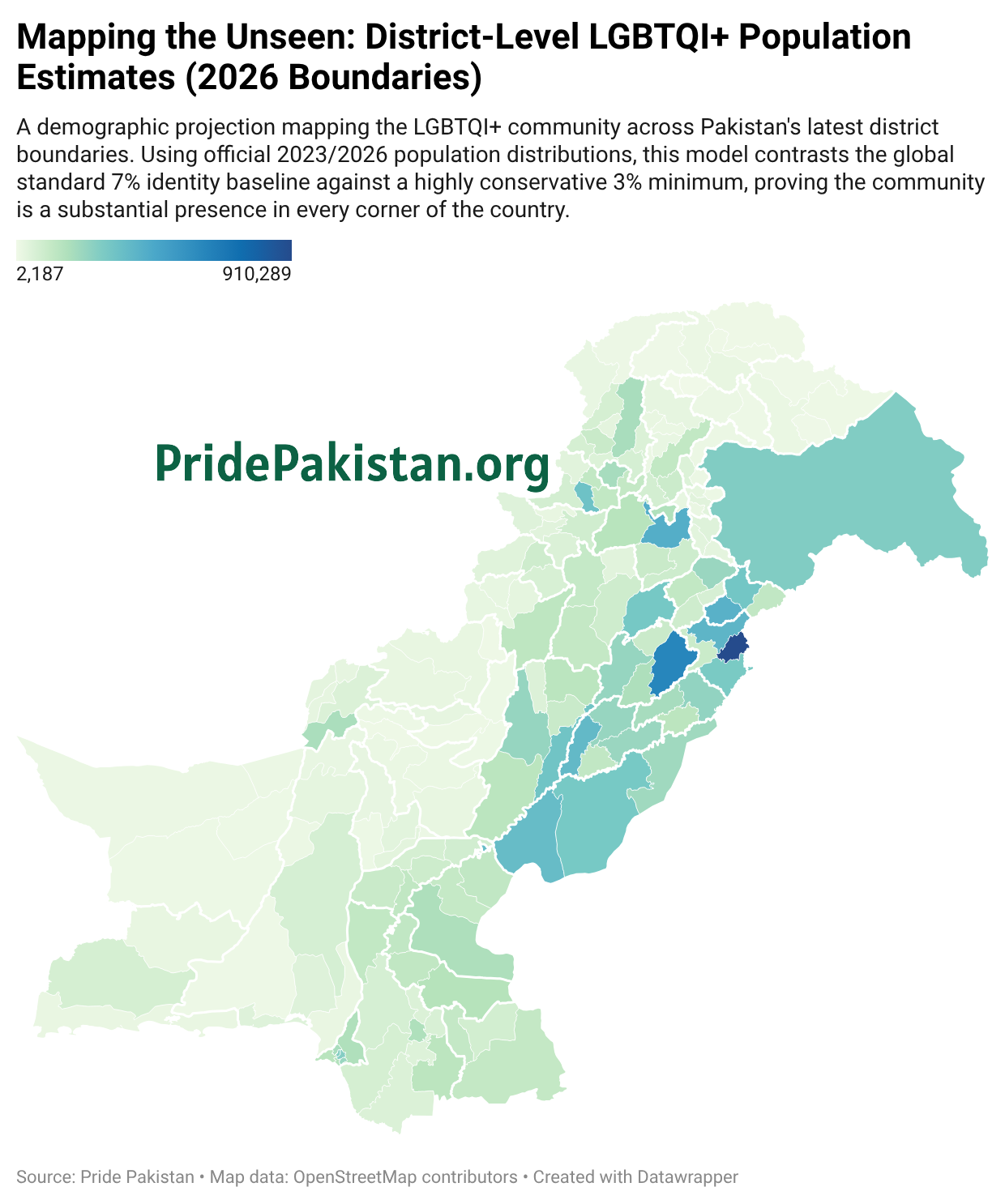
Following rigorous demographic tracking and standard public health estimation methods, PridePakistan.org has developed the first comprehensive, district-by-district population projection model for the country. This study moves away from internet rumors and utilizes proven scientific frameworks to look at the real numbers.
The Science: Is This Data Scientifically Verifiable?
In public health and sociology, when actual national census data on marginalized or criminalized communities is missing, demographers rely on statistical extrapolation.
The 7% Standard Identity Baseline
Decades of independent, comprehensive demographic peer-reviewed research conducted across diverse continents—compiled by institutions like the Kinsey Institute and the Williams Institute—consistently reveal that sexual and gender minorities safely constitute between 5% to 10% of any given human population. This range remains stable regardless of local geographic boundaries, governance structures, or social systems.
To create our model, PridePakistan.org applied a standard, realistic 7% demographic multiplier to Pakistan’s total 2023 National Digital Census population (which stands at approximately 241.5 million people). This yields a scientifically defensible national baseline estimate of 16.9 million LGBTQI+ individuals across the country.
The 3% Conservative Minimum Range
To account for absolute mathematical caution and handle skeptics, our dataset concurrently provides a 3% absolute minimum baseline. Even at this exceptionally narrow margin, the statistics demonstrate that queer individuals constitute a substantial and undeniable percentage of every administrative block in the country.
National and Provincial Population Breakdown
Based on the 7% standard identity multiplier and the 3% conservative threshold applied directly to the latest state data, here is the official breakdown of the estimated LGBTQI+ population by administrative zone:
| Province / Territory | Official 2023 Census Population | Estimated LGBTQI+ Population (7% Standard) | Conservative Minimum Range (3% Floor) |
| Punjab | 127,688,922 | 8,938,224 | 3,830,667 |
| Sindh | 55,696,147 | 3,898,730 | 1,670,884 |
| Khyber Pakhtunkhwa | 40,856,097 | 2,859,926 | 1,225,682 |
| Balochistan | 14,894,402 | 1,042,608 | 446,832 |
| Islamabad Capital Territory | 2,363,863 | 165,470 | 70,915 |
| Azad Jammu & Kashmir (AJK) | ~4,000,000 | 280,000 | 120,000 |
| Gilgit-Baltistan (GB) | ~1,500,000 | 105,000 | 45,000 |
| TOTAL NATIONWIDE ESTIMATE | ~249,500,000 | ~17,289,958 | ~7,410,000 |
Why This Data Matters
In an environment where state policy enforces invisibility, recording our own history is a necessity. This project proves that queer individuals are not an isolated anomaly or a tiny fringe element; they are millions of citizens living across every province, federal territory, and rural union council in Pakistan.
By grounding these numbers in clear, international demographic formulas rather than social media speculation, this dataset serves as a resource for human rights defenders, researchers, and public health advocates working toward safe, inclusive futures.
Explore the Live Interactive Map
Our data maps the community across all four provinces, the federal capital, and regional territories. Hover over your district below to see the standard demographic estimates and conservative baseline ranges of our community members living there
Leave a Reply