From a colonial-era criminal code to a national internet firewall, the machinery that keeps queer Pakistanis silent has never been larger — or better documented. A review of the laws, the violence, and the crackdown of 2024–2026.
By Qasim Shah | Pride Pakistan | 7 July 2026
On the night of 10 September 2025, police in Swabi district, Khyber Pakhtunkhwa, raided a musical show and arrested 226 people. Among those taken were transgender performers whose only livelihood is dancing at such gatherings. Within days, a committee of local elders had formed with a single stated purpose: to expel every transgender person from the district.
Trans residents told reporters they were afraid to leave their homes. ILGA Asia condemned the campaign as targeted harassment demanding the attention of the international community. No one was arrested that night for violence. No one was arrested for theft. They were arrested for music, for dancing, and — beneath the official language of “obscenity” — for existing in public while being the wrong kind of person.
This is what persecution looks like in Pakistan today. It is rarely a courtroom. It is a raid, a mob, a family council, a blocked website, a phone call that begins with a slur. This article sets out, with sources, how that machinery works.
The law: a colonial inheritance Pakistan chose to keep
The foundation is Section 377 of the Pakistan Penal Code, drafted by British colonial administrators in 1860 and retained ever since. It criminalises “carnal intercourse against the order of nature” and carries penalties ranging from two years to life imprisonment, according to the Human Dignity Trust’s country profile.
Layered on top is the Hudood Ordinance of 1979, which imported Sharia-derived punishments — up to 100 lashes, and in theory death by stoning for married persons — for sexual relations outside marriage. No execution for same-sex conduct is known to have been carried out in Pakistan, but the death penalty’s theoretical availability does its work anyway: it tells every gay, lesbian and bisexual Pakistani what the state thinks their love is worth.
The state’s position is not a relic passively left on the books. In November 2022, the Punjab government banned the Cannes-winning film Joyland for depicting a relationship between a man and a transgender woman — a ban Amnesty International called on Pakistan to reverse, and which remains in force in Punjab even after the federal ban was lifted.
Rarely prosecuted, constantly weaponised
Defenders of the status quo sometimes point out that formal prosecutions under Section 377 are rare. This is true — and it profoundly misunderstands how the law is used.
Prosecutions do happen. Research compiled by the Immigration and Refugee Board of Canada, citing the Neengar Society, documented at least ten prosecutions under Section 377 in the city of Multan alone, two of which ended in ten-year prison sentences. In 2015, police in Jaffarabad, Balochistan, arrested two young men and their friends after reports of a secret “marriage”; the couple told investigators it had been a joke between friends. They were charged under Section 377 regardless.
But the law’s daily function is not prosecution. It is leverage. The same IRB research records what every queer Pakistani already knows: police use the threat of arrest to extort money and sexual favours, and blackmailers use the threat of exposure to extract everything else. A charge that will “probably be dropped” is still a night in a cell, a name in a police register, a family informed, a life ended in every way that matters. The UK Home Office’s own November 2025 Country Policy and Information Note records that gay men are targeted through dating apps for extortion and violence, and that state protection is, in practice, unavailable.
And when queer life becomes visible, the state reacts with force even without Section 377. In May 2024, a man who filed a simple application to open a gay social club in Abbottabad was committed to a psychiatric hospital, his friends barred from seeing him, while religious figures accused him of working for foreign powers.
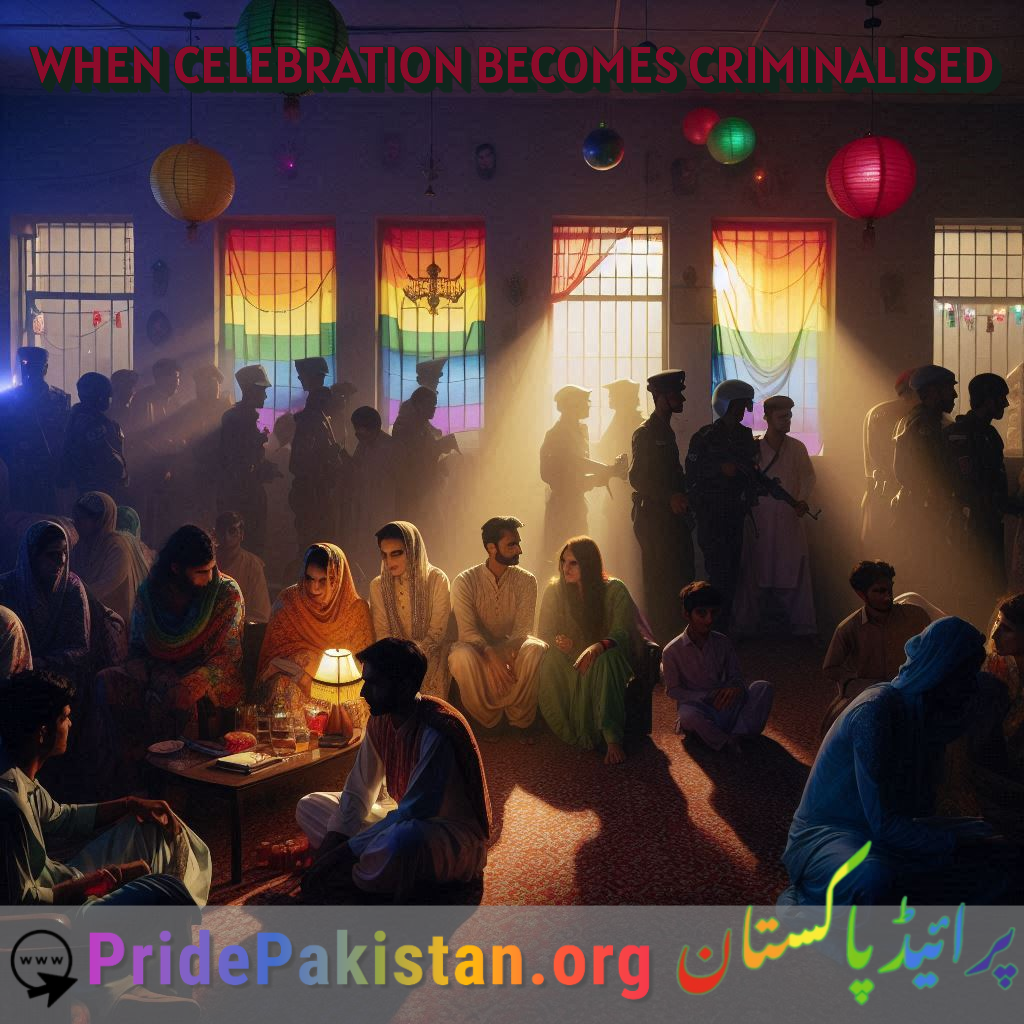
In August 2025, Lahore police arrested transgender people and others over a private party after videos went viral — a case a magistrate threw out for total lack of evidence, noting police had recovered no obscene material at all and had followed almost no lawful procedure. The dismissal is welcome; the raid is the point. As we wrote at the time, celebration itself has been criminalised.
The violence that never reaches a courtroom
For most LGBTQ+ Pakistanis, the greatest danger is not the police but the people closest to them. A survey cited in the UK Home Office’s country evidence documented 956 recorded violations against LGBTQ+ people between 2016 and 2022 — verbal harassment, sexual assault, rape, and physical abuse — with three-quarters of victims being transgender, and most victims knowing their attackers.
The patterns are grimly consistent:
- Gay and bisexual men are entrapped through dating apps by gangs who film, rob, blackmail and sometimes kill them. Families respond to discovery not with rejection alone but with violence, forced heterosexual marriage as a “cure”, and — in tribal and rural contexts — killing in the name of honour.
- Lesbian and bisexual women face forced marriage, domestic violence and so-called corrective rape, with even less visibility and even fewer avenues of escape.
- Family and community “justice” — the jirga, the elders’ committee, the honour code — operates as a parallel legal system from which there is no appeal. The Swabi expulsion committee is simply this system operating in the open.
The state does not merely fail to protect against this violence; its criminal law guarantees that victims cannot go to the police without confessing to a crime.
Transgender Pakistanis: rights granted, then taken back
Pakistan briefly appeared to be an exception on transgender rights. The Transgender Persons (Protection of Rights) Act 2018 recognised self-identified gender and offered anti-discrimination protections. But on 19 May 2023, the Federal Shariat Court struck down its core provisions as “un-Islamic”, ruling that gender cannot follow “self-perceived identity”. Activists are appealing, but the signal was received across the country.
What followed has been the most violent period for trans Pakistanis in recent memory. Local organisations documented 55 killings of transgender people in Sindh province between 2022 and September 2025, including 17 in Karachi. In September 2025, three transgender women were shot dead together on the outskirts of Karachi.
Reporting into early 2026 describes officials and violence together reversing a decade of fragile progress. Human Rights Watch’s World Report records that trans people are among the victims of honour killings by their own relatives.
The digital wall: erasing the community online
For a community that cannot gather in public, the internet was the only commons — and Pakistan is now walling it off. Under the Prevention of Electronic Crimes Act (PECA) 2016, more than 1.4 million URLs have been blocked, according to Freedom House’s Freedom on the Net 2025 report. In the 2023–24 financial year alone, of 109,771 URLs blocked, the majority — 55,723 — were blocked for “morality”: the administrative category under which queer life is deleted from the Pakistani internet.
Since 2024, the state has deployed a national firewall built on imported surveillance technology — the Web Monitoring System and Lawful Intercept Management System — whose rollout has been linked to nationwide connectivity disruptions and which Pakistan’s own press describes as an opaque instrument of control.
The practical effect for our community is simple: LGBTQ+ resources, health information and community platforms — including this organisation’s own website — are unreachable from inside Pakistan without circumvention tools that are themselves being squeezed.
An LGBTQ+ Pakistani in 2026 is thus cut off three times over: from public space by the mob, from legal protection by Section 377, and from the digital world by the firewall.
What the world’s own evidence says
None of this is hidden. The UK Home Office’s November 2025 country policy note itself records the dating-app entrapment, the forced marriages, the family violence, the absence of state protection, and the reality that most gay Pakistanis conceal their identity to survive. Immigration law practitioners have publicly criticised the note’s own summary for downplaying what its underlying evidence shows — a reminder that even the governments assessing our community’s safety must be held to their own sources.
The evidence is consistent across every serious body that has looked: the Human Dignity Trust, the ILGA World Database, OutRight International, Human Rights Watch, and the Immigration and Refugee Board of Canada. Criminalisation, family violence, police extortion, digital erasure, no protection. The record is not contested. It is only ignored.
If you need help
- Inside Pakistan: Prioritise your safety. Use a reputable VPN before accessing any LGBTQ+ resource, lock down social media privacy settings, and be extremely cautious with dating apps — entrapment gangs are active. Our community channels (contact details on this site) can connect you with discreet peer support.
- If you are in danger and need to leave: Rainbow Railroad helps LGBTQI+ people escape state and community violence.
- In the diaspora (UK): Galop supports LGBT+ victims of abuse and hate crime; Switchboard offers a listening service; Hidayah supports LGBTQI+ Muslims specifically.
- Documentation and advocacy: Human Dignity Trust, OutRight International, ILGA Asia, and Amnesty International all document violations in Pakistan; if you can safely record what happened to you, your testimony strengthens the record on which the world judges Pakistan.
Note: Anyone facing an immigration or protection decision should consult a qualified legal professional; nothing in this article is legal advice.
Conclusion: the cost of being seen
Pakistan’s persecution of its LGBTQ+ citizens does not need gallows or mass trials. It needs only what it already has: a law that makes us criminals, families licensed to punish us, police who profit from our fear, courts that undo our rights, and a firewall that deletes our voices.
The 226 people arrested in Swabi for attending a musical show; the man sent to a psychiatric ward for asking permission to open a club; the three women shot together in Karachi; the fifty-five killed in Sindh whose names most of Pakistan will never learn — they are not exceptions to the system. They are the system.
We publish this record because the first act of persecution is always the same: to make its victims invisible. We decline to be.
Pride Pakistan is a community organisation supporting LGBTQI+ Pakistanis at home and in the diaspora. Sources accessed and verified 7 July 2026.
References
- UK Home Office, Country Policy and Information Note — Sexual orientation and gender identity or expression, Pakistan (November 2025): gov.uk
- Free Movement, Concerns raised about changes to Home Office’s country evidence on Pakistan for LGBT+ people (2 January 2026): freemovement.org.uk
- Human Dignity Trust, Criminalisation of LGBT People in Pakistan: humandignitytrust.org
- Immigration and Refugee Board of Canada, Responses to Information Requests — Pakistan: irb-cisr.gc.ca
- Dawn, Swabi police arrest 226 people for ‘resisting raid on musical show’ (September 2025): dawn.com
- Dawn, Elders form body to ‘expel’ transgenders from Swabi (September 2025): dawn.com
- ILGA Asia, Pakistan: Targeted harassment and expulsion of transgender individuals across Khyber Pakhtunkhwa needs to stop (October 2025): ilgaasia.org
- NBC News, Three transgender women are shot and killed in Pakistan’s largest city (September 2025): nbcnews.com
- Erasing 76 Crimes, Anti-trans officials and violence reverse progress for transgender Pakistanis (3 February 2026): 76crimes.com
- JURIST, Pakistan Federal Shariat Court rules against landmark transgender rights legislation (May 2023): jurist.org
- NBC News, Pakistani trans activists to appeal Shariah court ruling (2023): nbcnews.com
- The Express Tribune, Gay couple arrested in Balochistan after secret ‘marriage’ (June 2015): tribune.com.pk
- PinkNews, Man held in mental hospital after trying to set up Pakistan gay club (10 June 2024): thepinknews.com
- Dawn, Case dismissed against transgender persons held for organising ‘objectionable’ party in Lahore (August 2025): dawn.com
- Human Rights Watch, Pakistan Province Bans Film about Trans Character (29 November 2022): hrw.org
- Amnesty International, Pakistan: Ban on film Joyland must be reversed immediately (November 2022): amnesty.org
- Freedom House, Freedom on the Net 2025: Pakistan: freedomhouse.org
- Dawn, Firewall confusion (editorial): dawn.com
- Human Rights Watch, World Report 2025: Pakistan: hrw.org
- ILGA World Database, LGBTI Rights in Pakistan: database.ilga.org
- OutRight International, Pakistan: outrightinternational.org
- Rainbow Railroad: rainbowrailroad.org
Leave a Reply