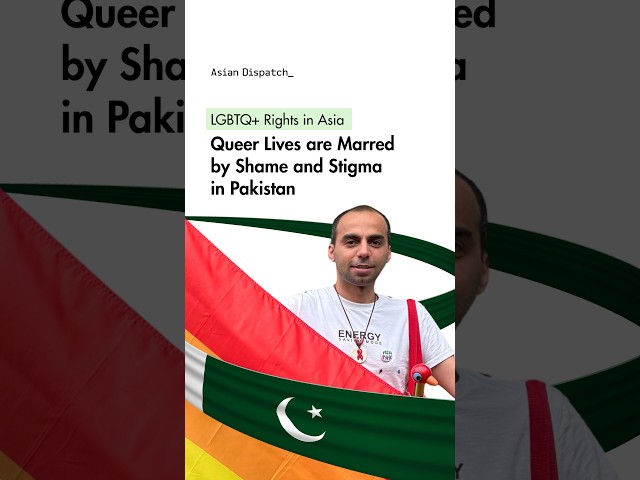
A Critical Journalism Initiative by Asian Dispatch
We extend our deepest gratitude and professional credit to Asian Dispatch, a premier independent journalistic platform dedicated to uncovering overlooked human rights narratives across Asia. Their team has produced a groundbreaking, deeply necessary video investigative series exploring the destructive legacy of colonial-era laws, specifically Section 377. By providing a platform for raw, uncensored testimonies, Asian Dispatch has highlighted the systemic challenges faced by marginalized communities in South Asia, breaking international silences on structural oppression.
At PridePakistan.org, our mission has always been to document the real, unvarnished pain of our community and challenge state-sponsored erasure with hard evidence. In this vital collaboration, our founder, Ali Raza Khan, alongside community members like Sumair, stepped forward to outline how colonial legal frameworks have evolved into modern systems of digital terrorism, illegal extortion, and forced institutionalization.
Video Transcript & Accessibility Hub
For differently-abled individuals, visually impaired community members using screen readers, or those unable to view the video content, we have provided the full, verbatim text script below.
Narrator / Text on Screen: That’s a clip from the 2022 Pakistani film Joyland. The film explores the issues of gender and sexuality in Pakistan—subjects that are still considered taboo. It depicts the societal discrimination that the queer community faces on a daily basis in the country. The film was initially banned for showing “objectionable content” but was eventually passed with cuts. What was shown on the big screen is the reality of the queer community in Pakistan.
Ali Raza Khan, an activist who works to support the LGBTQ+ community in Pakistan, says that before Section 377, queer love and gender diversity existed openly in the country’s cultural and spiritual traditions.
Ali Raza Khan: “Before the British arrived with their penal codes, our society deeply understood and accepted homosexual love as a valid emotional and spiritual reality. Look at the famous 16th-century Sufi poet Shah Hussain and his male lover Madhu Lal. Two men whose deep devotional and romantic bond was so celebrated that they are buried together in a single shrine in Lahore. Look at Bulleh Shah, who broke all gender norms, writing intense poetry of same-sex longing. Colonial rule destroyed this understanding.”
Narrator / Text on Screen: Under British rule, Section 377 criminalized same-sex relations and its legacy continued shaping public morality and social attitudes in Pakistan even after independence. But the impact of Section 377 goes beyond the law itself. Ali says digital surveillance, censorship, and police crackdowns have pushed queer communities away from public spaces.
Ali Raza Khan: “The modern state digital censorship apparatus did not stop at blocking pornographic websites; they systematically expanded their plan to target dating applications and more recently clamped down heavily on VPN services to completely cut off our community’s access to the outside world. State authorities maintain an active, malicious presence directly inside gay community platforms, hiding behind fake profiles exclusively to entrap, stalk, and target gay individuals.”
Narrator / Text on Screen: Ali says that the authorities often rely on morality laws to arrest individuals.
Ali Raza Khan: “This crackdown doesn’t just hit large organized networks like Naz; authorities actively hunt down all independent groups and private individuals attempting to coordinate underground gatherings across Pakistan. Take the horrific, definitive example of Preetum Giani in Abbottabad. He attempted to legally register an indoor safe space and a gay club—an act that violated no written statute. Yet, the state authorities arrested him and forcefully committed him to a mental health asylum in Peshawar.”
Narrator / Text on Screen: In 2024, 75-year-old Giani was arrested and sent to a mental asylum. His whereabouts remain unknown. For many queer Pakistanis, this fear exists not just in law or online spaces, but even inside their homes and workplaces. Sumair, a queer person from Karachi, says everyday life itself becomes a struggle.
Sumair: “LGBTQI+ people face teasing, insults, harassment, and sometimes physical violence. People judge them because of their appearance and identity. At home, family members often taunt them, emotionally harass them, and even tell them to leave the house—they make them feel like they do not belong. Many people also connect LGBTQI+ identity with religion in a negative way and say it is wrong in Islam.”
Narrator / Text on Screen: Sumair also highlights the lack of legal and institutional support for the community in the country, which leaves them vulnerable to abuse and exploitation. However, community-led organizations work silently and in hiding to create support systems, especially around mental health.
Sumair: “I connected with a local organization. He is making a safe space and working… first of all on mental health because all LGBTQI+ people are suffering from mental health situations like trauma, stress, and emotional struggling. They have therapists and they arrange many sessions about mental health, and I am a part of this organization and these mental health trainings also.”
Narrator / Text on Screen: But even within the broader queer movement, divisions remain. Ali says transgender groups are often forced to publicly distance themselves from the larger LGBTQ+ spectrum for survival.
Ali Raza Khan: “If transgender activists publicly associate with gay, lesbian, and bisexual groups, their own fragile legal protections are completely stripped away by the right-wing extremists. They are forced to refuse any public association with the broader spectrum purely as a desperate survival tactic. This state-crafted polarization has made it impossible for intersectional leaders to survive.”
Narrator / Text on Screen: Several other organizations that Asian Dispatch spoke to relayed this fear. And despite criminalization, censorship, violence, and isolation, queer Pakistanis continue to search for dignity, community, and the right to exist freely.
Sumair: “I want at least basic human rights for everyone. Every person deserves the right to live safely and with dignity.”
Watch the Full Investigation
To see the full visual reporting, analytical graphics, and cinematic presentation prepared by the Asian Dispatch team, watch the official release here:
- 📱 Watch on Instagram: https://www.instagram.com/reel/DZCqhilxxzj
- 📺 Watch on YouTube: https://www.youtube.com/watch?v=Hm4TZvZMwt4&t
Leave a Reply