
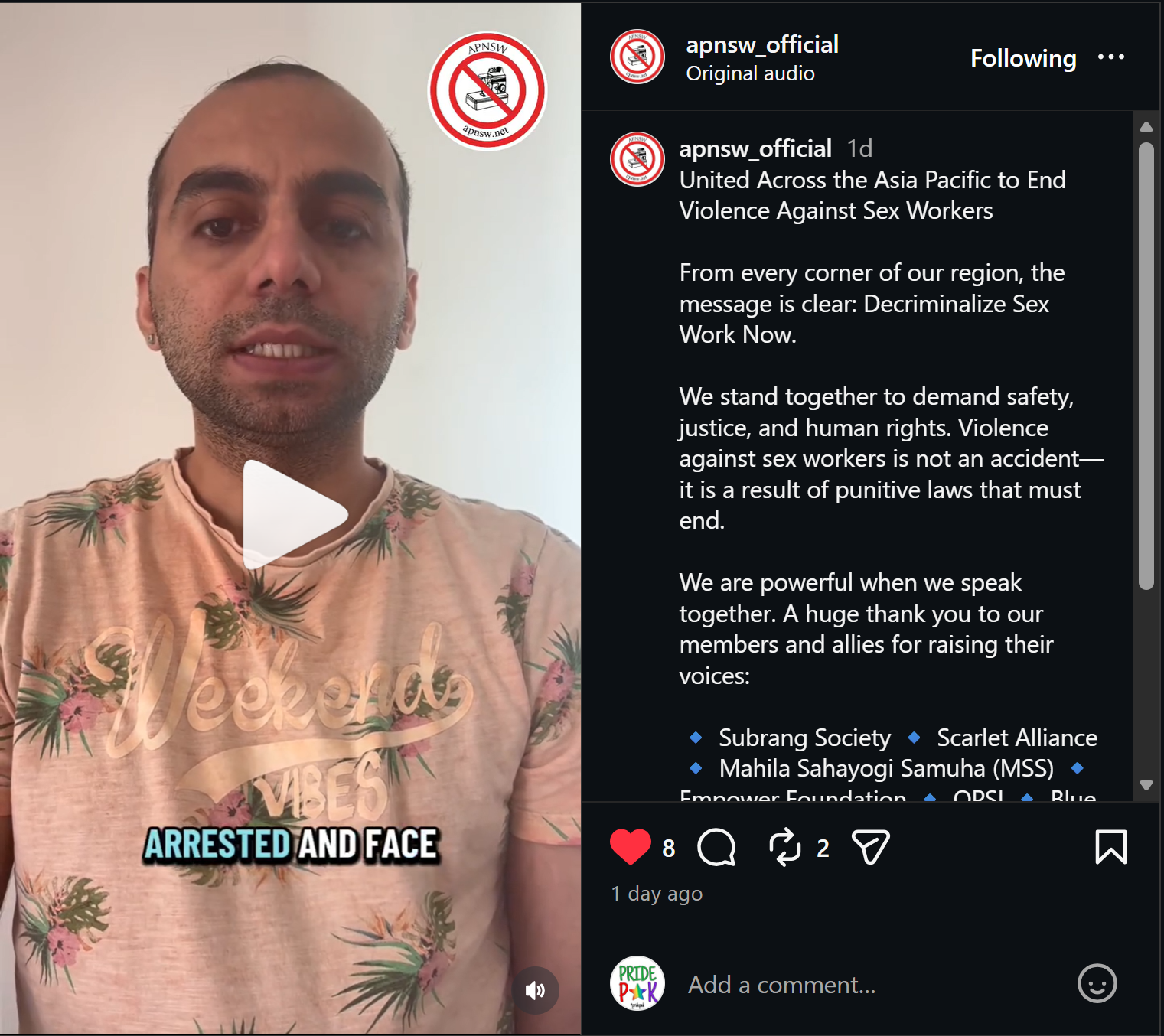
At Pride Pakistan, our mission has always been to advocate for the most marginalized voices within our community. This year, for the International Day to End Violence Against Sex Workers, our founder Ali Raza Khan joined the Asia Pacific Network of Sex Workers (APNSW) in a landmark regional campaign.
Speaking as a gay sex worker from Pakistan, Ali highlighted a truth that is often silenced: in our patriarchal society, the criminalization of sex work doesn’t “protect” anyone—it actively facilitates violence, particularly against Male Sex Workers (MSWs) and Men who have sex with men (MSM).
The Invisible Crisis: Male Sex Workers in Pakistan
In Pakistan, the discussion around sex work is often limited to female workers, leaving MSWs in a state of extreme vulnerability. According to recent data, the numbers and the risks are staggering:
- Population Estimates: UNAIDS estimates there are approximately 832,200 men who have sex with men (MSM) in Pakistan, a significant portion of whom engage in sex work for survival or livelihood (UNAIDS, 2024).
- HIV Vulnerability: While the national HIV prevalence in the general population is low, it is disproportionately high among key populations. Men constitute 69.4% of new HIV cases reported in 2024, often due to a lack of access to safe working conditions and health services (The News International/Ministry of Health, 2024).
- Systemic Violence: Research shows that criminalization drives sex work underground, making it nearly impossible for MSWs to report violence. A 2025 Global Torture Index report classifies Pakistan as “high risk,” noting that police regularly employ torture and extortion against vulnerable individuals, including LGBTQIA+ and sex-working communities (OMCT, 2025).
Why Decriminalization is the Only Path Forward
Criminalization creates a “culture of impunity.” When a male sex worker is robbed, beaten, or extorted, he cannot go to the police because the law views him as the criminal. This allows perpetrators—including state actors—to target our community without fear of consequence.
Decriminalization is not just a legal shift; it is a life-saving intervention. It allows for:
- Access to Justice: The ability to report crimes without fear of arrest.
- Health Rights: Improved access to HIV prevention, ART, and mental health support.
- Workplace Safety: The ability to negotiate safe sex and refuse dangerous clients.
Official Statement from PridePakistan.org
“On this International Day to End Violence Against Sex Workers, Pride Pakistan stands in unwavering solidarity with sex workers of all genders. We recognize sex work as work and demand an immediate end to the criminalization that fuels the torture and humiliation of our community members.
We call upon the Government of Pakistan to align with international human rights standards and recognize that you cannot end violence while you continue to criminalize the victims. Safety, dignity, and healthcare are human rights—not privileges to be revoked based on how one earns a living.”
You can watch the regional solidarity video featuring Ali Raza Khan on the APNSW Facebook Page
Youtube Page: International Day to End Violence Against Sex Workers – YouTube
or Instagram: https://www.instagram.com/p/DSW1WqHjfGw/
and join the conversation using the hashtags below.
#PridePakistan #EndViolenceAgainstSexWorkers #DecriminalizeSexWork #MSWRights #SexWorkIsWork
References:
1. UNAIDS Pakistan Data (2024–2025)
- Link: UNAIDS Pakistan Country Page
- Key Detail: Provides the estimate of 832,200 men who have sex with men (MSM) in Pakistan and tracks the “fastest-growing HIV epidemic” in the region.
2. Global Torture Index 2025 (OMCT)
- Link: Global Torture Index 2025: Pakistan Factsheet
- Key Detail: Classifies Pakistan as a “High Risk” country where police regularly employ torture against marginalized groups, including LGBTQIA+ and sex workers.
3. WHO & Ministry of Health Reports (2024–2025)
- Link: WHO EMRO – HIV Infections Rise in Pakistan (Dec 2025)
- Key Detail: Documents that new infections rose significantly in 2024–2025, with males constituting approximately 69.4% of new cases.
4. APNSW Regional Campaign
- Link: Asia Pacific Network of Sex Workers (APNSW) Official Website
- https://www.youtube.com/shorts/FSjCMoTyowc
5. Human Rights Watch / Amnesty International (2025)
- Link: HRW World Report 2025: Pakistan
- Link: Amnesty International: State of the World’s Human Rights 2025
Further Reading & References:
- UNAIDS (2024):Pakistan HIV & Key Population Estimates
- OMCT (2025):Global Torture Index – Pakistan Human Rights Factsheet
- World Health Organization (2025):Urgent Action Needed as HIV Infections Rise in Pakistan
Leave a Reply